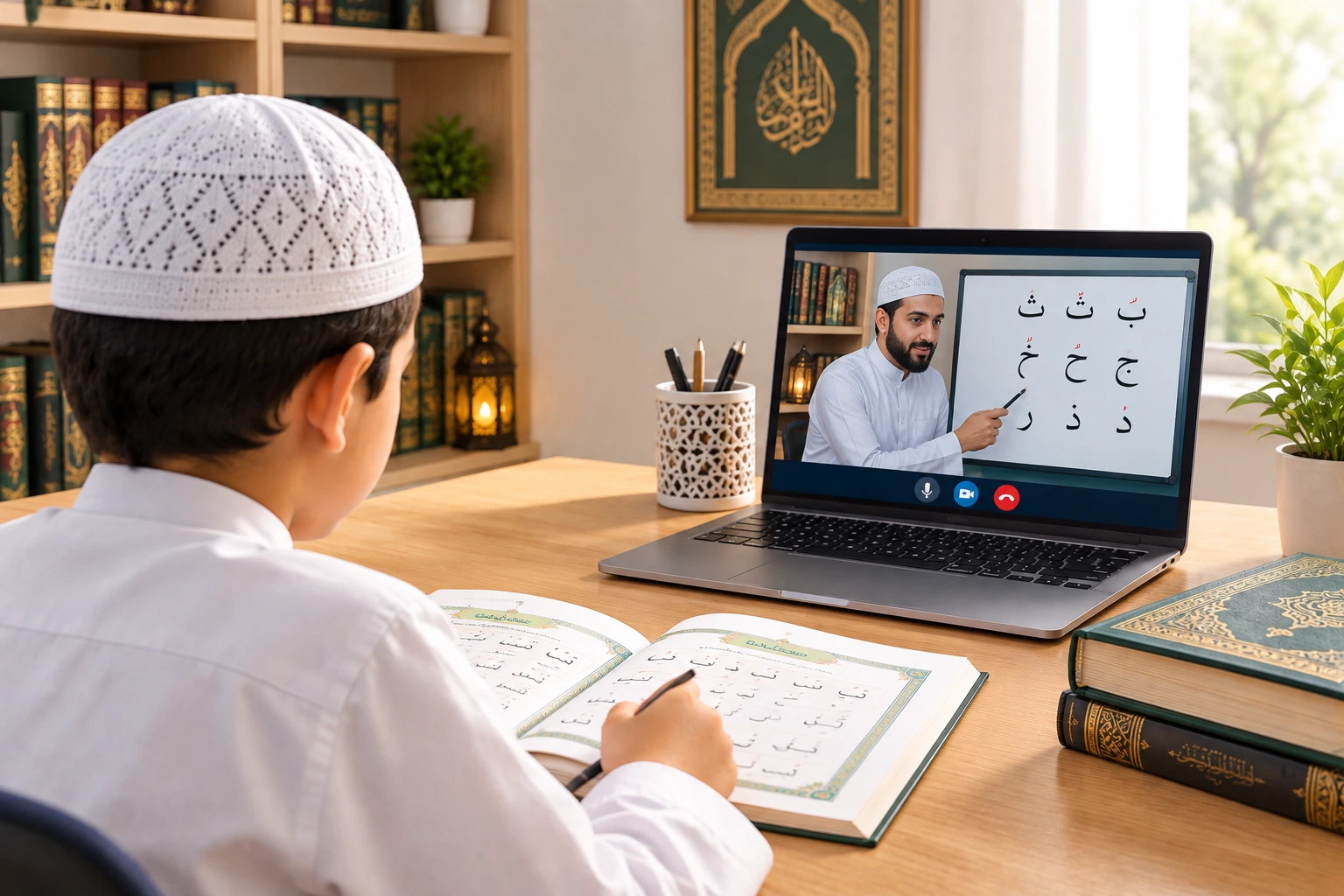
Children's Quran education can connect recitation with understanding, reflection and everyday conduct. Memorizing alone is not the whole purpose; a suitable lesson also explains age-appropriate meanings and encourages practice of good behaviour.
The source promoted online Quran, Tajweed, Arabic and Islamic studies classes as a route to that learning. Home study can be convenient, but suitable instruction and patient family support remain necessary.
Table of Contents
- Quranic Guidance as the Foundation
- 1. Moral Values
- 2. Spiritual Development
- 3. Guidance
- 4. Patience and Attention
- 5. Character Development
- 6. Language and Learning Skills
- 7. Cultural Understanding
- 8. Belonging and Care
- 9. Social Interaction
- 10. Respectful Relationships
- Five Potential Advantages of Online Lessons
- Four Children's Course Categories
- Evaluate the Teacher
- Five Steps before Enrolment
- Frequently Asked Questions
Quranic Guidance as the Foundation
Al-Isra 17:9 states: إِنَّ هَـٰذَا الْقُرْآنَ يَهْدِي لِلَّتِي هِيَ أَقْوَمُ وَيُبَشِّرُ الْمُؤْمِنِينَ الَّذِينَ يَعْمَلُونَ الصَّالِحَاتِ أَنَّ لَهُمْ أَجْرًا كَبِيرًا. The passage connects the Quran's guidance with righteous deeds and good news of reward.
Hifz may be one part of study, but it need not be every child's first or largest assignment. Consider reading readiness, understanding and a manageable pace.
1. Moral Values
Ash-Shura 42:37 includes avoiding major sins and responding to anger with forgiveness. Use suitable examples to discuss honesty, kindness, patience and the difference between helpful and harmful conduct.
2. Spiritual Development
Ar-Rad 13:28 connects remembrance of Allah with hearts finding reassurance. Teach children familiar remembrance and a relationship with worship without demanding that every lesson produce a particular feeling.
Questions about purpose and gratitude can grow alongside recitation. Religious education should leave room for sincere questions.
3. Guidance
Al-Baqarah 2:2 describes the Book as guidance for the God-conscious. Help children connect an explained teaching with a real situation rather than present a short quotation as an instant answer to every difficulty.
4. Patience and Attention
Al-Baqarah 2:45 directs seeking help through patience and prayer. Learning a passage and revisiting corrections can provide practical opportunities for perseverance.
The source guaranteed improved focus and endurance. Those are possible learning aims, not established outcomes for every child or replacements for individual support needs.
5. Character Development
Al-Qalam 68:4 praises the Prophet's character. Discuss humility, gratitude, perseverance and empathy through clear examples. Adults' conduct should support the values taught in the lesson.
6. Language and Learning Skills
Arabic reading can develop familiarity with letters, sounds and vocabulary. Memorization provides recall practice; discussion gives opportunities to explain and compare ideas.
The source attributed a statement about Arabic increasing intelligence to Musnad Ahmad without a usable reference. Do not present it as a verified prophetic saying. It also promised significant memory and analytical improvements without research details; general practice does not prove a unique cognitive advantage.
7. Cultural Understanding
Al-Hujurat 49:13 discusses peoples and tribes knowing one another and honour based on righteousness. Use that message to encourage respect across cultures.
Children may also explore Arab cultures and Islamic traditions, while recognising that Islam and Muslim communities extend beyond one language or ethnicity.
8. Belonging and Care
Al-Hujurat 49:10 describes believers as brothers and calls for reconciliation. Connect belonging with fairness, kindness and repairing disagreements rather than excluding others from a classroom.
9. Social Interaction
Mosques, classes and community activities can give children opportunities to learn with peers. Bukhari 645 mentions a twenty-seven-degree advantage for congregational prayer; that reward is not evidence that every group class teaches more effectively.
10. Respectful Relationships
Al-Isra 17:23 teaches worship of Allah and kind speech to parents. Children can learn courtesy towards parents, teachers and community members.
Respect does not mean unlimited obedience to every instruction from an adult. Teaching good conduct should include permission to ask questions and tell a trusted person when something is wrong.
Five Potential Advantages of Online Lessons
- Scheduling: home lessons may offer suitable morning or evening times; check real availability.
- Individual attention: one-to-one lessons can allow close listening where that format is offered.
- A familiar setting: parents can help organise and observe learning without assuming home study automatically removes anxiety or distractions.
- Teacher access: distance may be less restrictive when a qualified instructor teaches online.
- Interactive practice: selected videos, games, quizzes and stories can support a defined learning task.
Four Children's Course Categories
The source listed Quran recitation for pronunciation and fluency, Tajweed for recitation rules, Arabic for language understanding, and Islamic studies for history, etiquette, prayers and prophetic stories. Distinguish those aims when selecting a course.
Evaluate the Teacher
The original provider claimed certified tutors in Quran, Tajweed, Arabic and Islamic studies; native speakers; child-teaching experience; and graduates of institutions including Al-Azhar and Madinah. Those are advertising claims requiring verification, not established Talqeen credentials.
Ask about the individual teacher's relevant expertise, patience and experience with the child's level. Native language alone is not a guarantee of accurate recitation instruction.
Five Steps before Enrolment
- Read the provider's actual children's course descriptions.
- Match a course with the learner's needs and interests.
- Check the registration process and required details.
- Observe an available trial to assess the teaching.
- Confirm suitable scheduling and enrolment arrangements.
The source advertised ongoing support and a smooth process; verify the actual service. Consult course information, parent support ideas and memorization readiness.
Patient Quran learning can support faith and good conduct. A course should provide appropriate guidance without guaranteeing a transformed personality or effortless progress for every child.
 Talqeen Academy
is a globally recognized platform for learning the Quran, Arabic,
and Islamic Studies through personalized one-on-one online sessions with expert tutors.