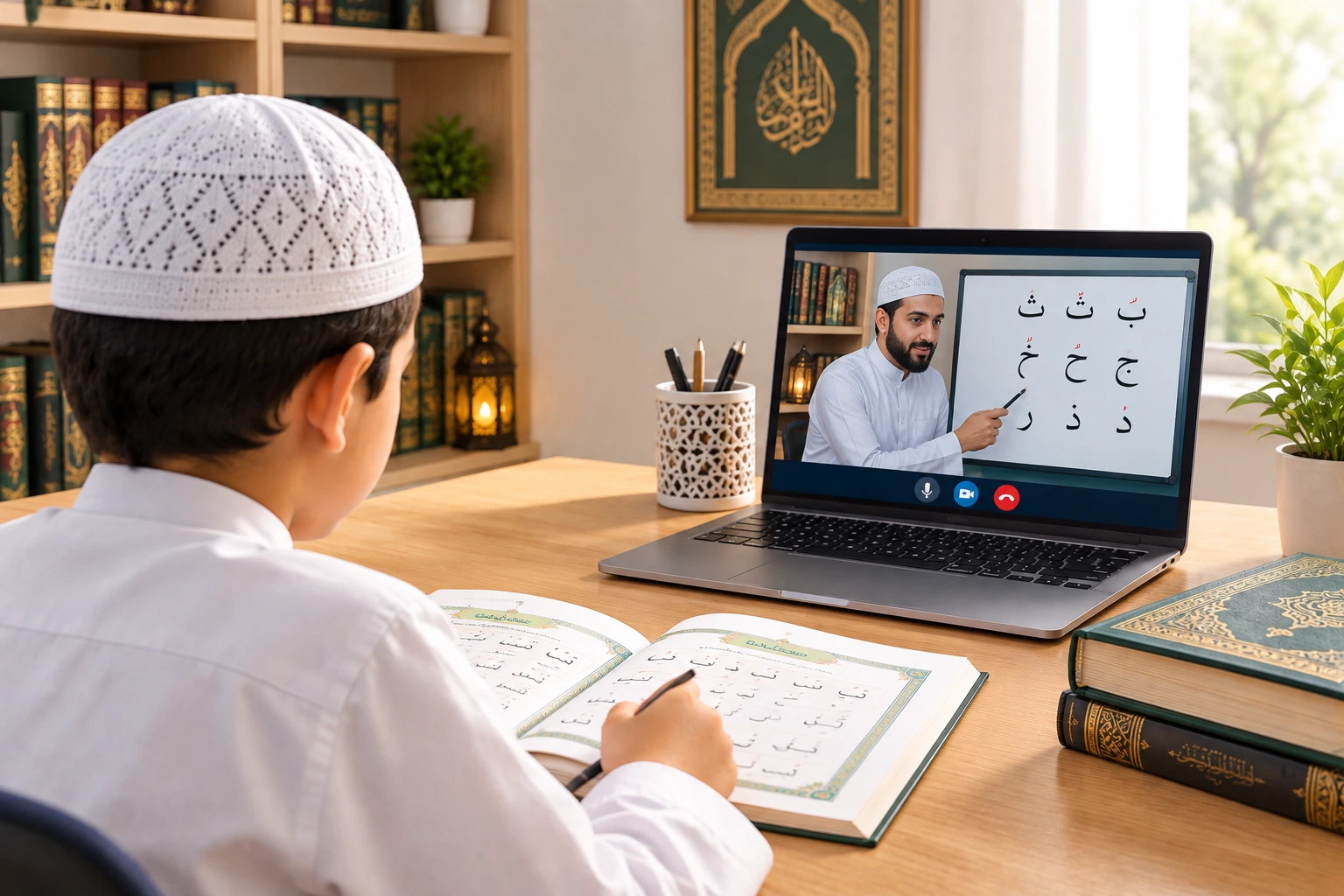
Many parents hope their child will recite confidently and develop a lasting relationship with the Quran. Deciding when to begin structured memorization requires more than choosing a starting age: the child's interest, learning needs and available support all matter.
The eight signs below are practical observations, not a validated readiness test. A child need not demonstrate every sign before learning a short passage, and the presence of all eight does not guarantee completion of a full Hifz programme.
Table of Contents
- What Quran Memorization Involves
- Does Starting Age Decide Readiness?
- Eight Signs to Discuss with a Teacher
- Five Ways to Prepare a Child Who Is Not Ready
- Four Helpful Roles for Parents
- What Online Lessons Can Offer
- Seven Programme Types Mentioned in the Source
- Choose a Sustainable Beginning
- Frequently Asked Questions
What Quran Memorization Involves
Hifz means memorizing, whether a short passage or the whole Quran. A full programme aims at accurate recall of the complete text, with appropriate recitation and continuing revision. Learning new portions without maintaining older ones is an incomplete plan.
The source associated Hifz with faith, discipline, concentration, patience and confidence. These are worthwhile educational aims, but they should not be promised as automatic outcomes for every child. The report in Abu Dawud 1464 encourages Quran recitation; a course cannot guarantee a particular rank or reward.
Does Starting Age Decide Readiness?
The original mentioned ages four to seven as common starting ages, with examples of children beginning at nine, eleven or in their teens. It supplied no population data establishing those ages as a measured norm or an optimum.
A teacher can help assess the child rather than rely on age alone. See age and Quran memorization for guidance covering different stages of life.
Eight Signs to Discuss with a Teacher
1. Your Child Can Engage with a Short Activity
The source suggested fifteen to twenty minutes of attention and introductory sessions lasting ten to fifteen minutes. These are example durations, not admission requirements. Some children learn well in much shorter periods or need breaks and accessible teaching arrangements.
Observe whether your child can listen, repeat and accept a small correction without becoming overwhelmed. Begin with a duration that works, then review it as familiarity grows.
2. Your Child Enjoys Listening to Quran Recitation
Asking to hear a passage again or recognising a familiar reciter can show interest. A child may enjoy the sound before understanding the words; nurture that interest through attentive listening and simple explanation.
Following a melody or humming does not establish accurate pronunciation. Memorization needs carefully modelled words and correction, rather than imitation of sound alone.
3. Your Child Has Learned Some Short Surahs
The original named Al-Fatihah, Al-Ikhlas and Al-Falaq as examples. Familiar passages can give a teacher useful information about recall, pronunciation and revision habits.
Prior memorization is helpful information, not a universal entry condition. A beginner can start with appropriately small material, and quick recall of one short surah does not prove readiness for the workload of memorizing the whole Quran.
4. Your Child Asks Questions About the Quran
Questions about meaning, Arabic or learning more can reveal curiosity. Answer at a level the child understands and welcome questions without treating them as disrespectful.
Simple explanations can connect memorization with understanding. Curiosity is worth supporting even when the child is not yet ready for a demanding course.
5. Your Child Is Comfortable with Repetition
Repeating a familiar story, cartoon phrase or song may show willingness to revisit something enjoyable. The source used these examples to introduce repetition, sometimes called tikrar, and revision, or murajaa.
Quran learning still needs accurate models and feedback. Enjoying familiar repetition does not establish that extended memorization will be easy; keep exercises manageable and maintain previously learned material.
6. Your Child Is Learning Arabic Reading
Recognising letters and studying a Qaida can support independent reading and correction. Decoding Arabic writing and understanding Arabic meaning are different skills, so do not assume one establishes the other.
Oral memorization and basic reading can develop together where a teacher considers that suitable. Some children need more foundational work first; others can learn short passages while improving their reading.
7. Your Child Responds to Encouragement
Small achievements and praise for effort can help a child return to practice. Motivation naturally varies from day to day, and a difficult session does not prove that the child is unsuited to learning.
The source described this as emotional readiness for a long journey. Use it as a reason to consider how encouragement works for this child, rather than a psychological test or a promise of sustained motivation.
8. Your Child Expresses a Wish to Memorize
A child's own interest is valuable. Ask what they would like to learn and explain the difference between learning a favourite surah and joining a full memorization programme.
Interest should meet practical support, reliable teaching and a realistic schedule. Avoid pressure: enthusiasm alone does not predict a completion date, and an unwilling child may benefit from a gentler introduction.
Five Ways to Prepare a Child Who Is Not Ready
- Listen to accurate recitation together at appropriate times, including relaxed home routines or journeys. Background audio can build familiarity but does not replace attentive learning.
- Learn simple duas with their meanings, explaining how remembrance connects with everyday life.
- Share reliable, age-appropriate stories about prophets, companions and Quran learning. Check details rather than invent inspiring achievements.
- Introduce letters and a suitable Qaida when the child is ready. The source mentioned provision from age four; actual suitability depends on the child and the course.
- Consider an introductory Quran class before a full Hifz programme, with goals focused on familiarity, reading and confidence.
Four Helpful Roles for Parents
Support regular revision. The original contrasted fifteen minutes daily with two hours once a week; that comparison is an illustration of routine, not a research finding proving a fixed advantage for every learner. Agree on a workable pattern with the teacher.
Avoid comparisons with siblings, cousins or classmates. Different starting skills and circumstances require different targets, and a slower pace should not become a judgement about a child's faith.
Make room for family recitation where the child is comfortable, perhaps before bed or during another suitable quiet period. Dinner and journeys were source examples, not required performance times. Some children prefer private practice rather than reciting to an audience.
Look for a patient teacher who can assess, correct and adapt lessons. Motivation and teaching expertise should be demonstrated in practice, rather than inferred from advertising.
What Online Lessons Can Offer
The source highlighted individual attention, schedules compatible with school and activities, learning at home, progress reports and access to teachers across locations. Ask how each feature operates in the actual course.
Online provision does not inherently outperform every in-person class. Compare the child's engagement, connection quality, home environment and teaching support. Claims about certified native-speaking Huffaz or Ijazah holders require checking the relevant qualifications.
Seven Programme Types Mentioned in the Source
The following preserves the original course categories and suggested audiences. These are descriptions from the source, not confirmation that another provider offers the same programmes or age limits.
| Programme | Audience described in the source | What to verify |
|---|---|---|
| Hifz for Kids | Children aged 4–14 | Actual age policy, assessment and child-appropriate workload |
| Online Hifz | Learners of different ages seeking structure | Lesson format, corrected practice and revision support |
| Hifz for Beginners | First-time memorization learners | Entry reading expectations and introductory targets |
| Intensive Hifz | Learners seeking a faster schedule | Realistic daily demands and retention monitoring |
| Full-Time Hifz | Learners able to dedicate substantial time | Education balance, supervision and hours |
| Quran for Kids | Beginners not yet entering full Hifz | Reading, short passages and gradual preparation |
| Noorani Qaida | Learners developing Arabic reading foundations | Placement, teaching approach and progression |
Compare current Quran, Hifz, Qaida and Tajweed course information with your child's assessment. Read a children's Hifz timetable, teacher selection guidance and revision methods when planning.
Choose a Sustainable Beginning
The source suggested three to five lessons weekly alongside daily revision. That is one possible arrangement, not an established optimum. Agree on frequency according to lesson length, the child's needs and other responsibilities.
Forgetting calls for planned revision and supportive correction, not punishment. A well-learned short surah still needs maintenance; the original promise that a childhood surah will never be forgotten was too absolute.
Parents can encourage sincerity and make dua while supporting practical learning. Avoid promising a precisely quantified share of every future recitation or a guaranteed spiritual outcome. Children who learn only part of the Quran can still benefit from accurate recitation, understanding and practice.
If considering a trial, confirm the actual terms rather than assume it is free or without commitment. The useful next step is an assessment and a realistic plan that the child, parent and teacher can sustain together.
 Talqeen Academy
is a globally recognized platform for learning the Quran, Arabic,
and Islamic Studies through personalized one-on-one online sessions with expert tutors.