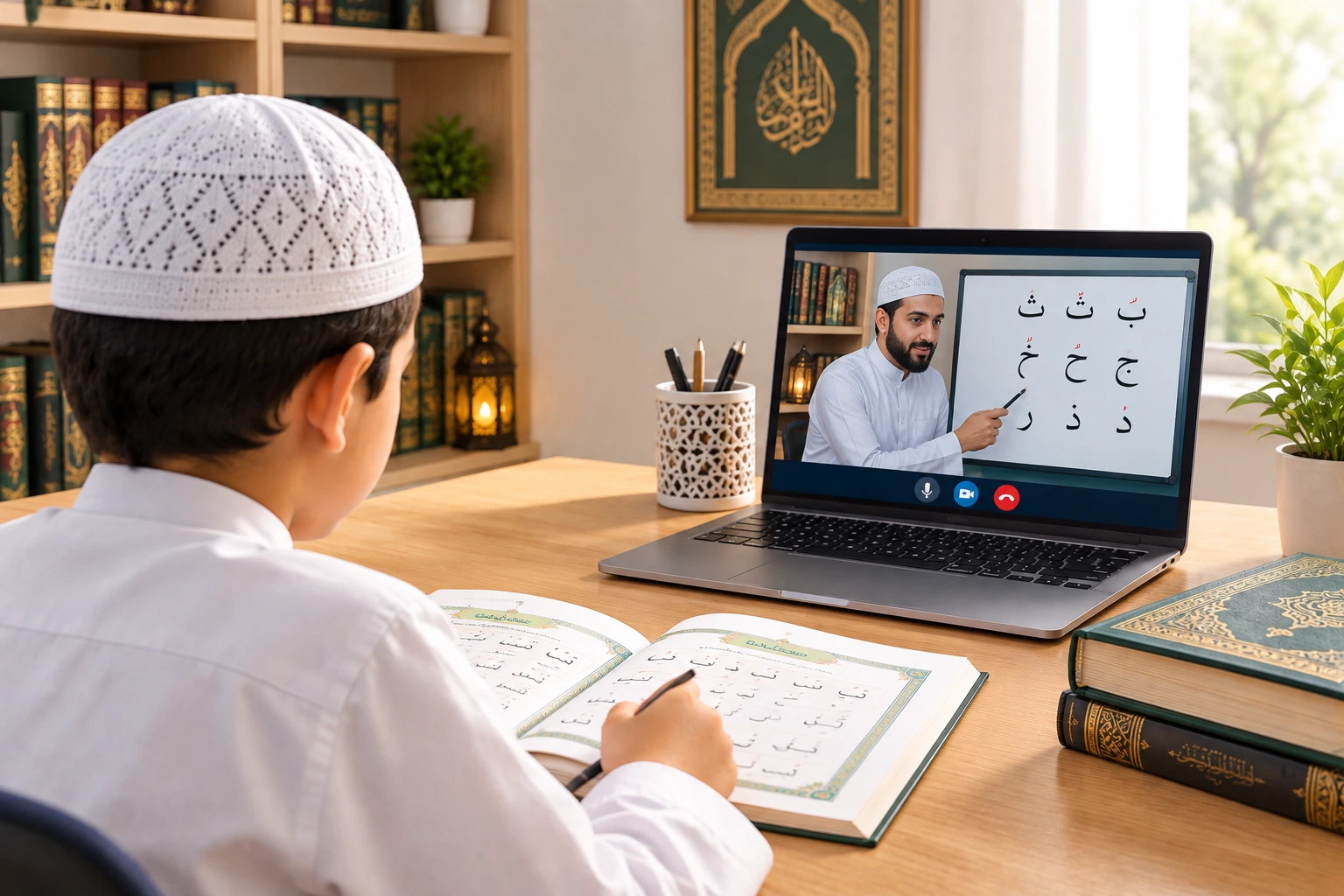
Islamic studies can give children language for discussing faith, conduct and responsibility. Lessons are most meaningful when adults model what they teach and let children ask questions. An early introduction should fit readiness rather than promise that one course automatically produces a particular personality.
The source presented ten character goals and linked them with general scientific claims. No specific research was supplied for those developmental outcomes. The religious references and practical themes are retained here without guaranteeing mental-health, social or behavioural results.
Table of Contents
- 1. Build a Moral Vocabulary
- 2. Practise Compassion and Empathy
- 3. Respect Parents and Elders
- 4. Introduce Prayer as a Meaningful Routine
- 5. Encourage Honesty and Integrity
- 6. Explain Responsibility without Excessive Fear
- 7. Notice Blessings and Thank Others
- 8. Teach Patience through Appropriate Ramadan Learning
- 9. Learn about Zakat and Giving
- 10. Practise Community and Cooperation
- Raising and Supporting Children
- Frequently Asked Questions
1. Build a Moral Vocabulary
Discuss honesty, kindness and justice through examples children recognise. Bukhari 3559 praises good manners and character. Ask what a fair or truthful choice might look like, then show it in everyday interactions.
Learning a value early can provide a foundation, but it does not make right and wrong automatically obvious in every future situation. Continue discussion and respectful correction.
2. Practise Compassion and Empathy
Bukhari 5997 places mercy in a concrete context involving affection towards a child. Invite children to notice another person’s feelings, offer help and use kind words.
The source associated empathy with emotional intelligence and social success. Treat those as general aspirations rather than a demonstrated result of this particular curriculum. Children need examples and opportunities to practise, not merely instructions to be compassionate.
3. Respect Parents and Elders
Quran 17:24 concerns humility and mercy towards parents. Abu Dawud 4943 connects mercy towards the young with respect for elders. Discuss gratitude for care and how to listen to experience respectfully.
Respect does not require children to hide harm or avoid every question. Adults should model considerate disagreement and make it safe to ask for help. Family bonds grow through reciprocal care, not obedience taught without context.
4. Introduce Prayer as a Meaningful Routine
Learning the daily prayers can introduce preparation, commitment and attention. The source cited Abu Dawud 495, which mentions instruction at seven, a historical disciplinary provision at ten, and separate sleeping arrangements.
The report is retained as a source reference, not converted into a practical instruction to strike a child. Teach through demonstration, explanation, encouragement and safe, nonviolent guidance. Ask qualified scholars about interpretation and individual circumstances. A structured routine does not by itself guarantee emotional control.
5. Encourage Honesty and Integrity
The source cited Muslim 2607a on truthfulness leading to righteousness. Show why honest reporting matters when mistakes occur, and respond in a way that does not make concealment seem safer than telling the truth.
Trustworthiness can be practised through returning belongings, keeping a promise and acknowledging an error. The source’s claims about self-esteem and peer respect were not supported by identified studies and should not be promised as automatic consequences.
6. Explain Responsibility without Excessive Fear
Bukhari 893 concerns responsibility for those entrusted to one’s care. Adults can use this reminder to consider their own conduct as well as teaching children accountability.
- Reflect on choices and seek forgiveness for mistakes.
- Practise kindness and avoid harm.
- Take promises seriously.
- Seek Allah’s guidance when facing decisions.
Give children age-appropriate explanations of consequences and mercy. Accountability should not become a claim that every ordinary mistake proves spiritual failure.
7. Notice Blessings and Thank Others
The source cited Abu Dawud 4811 on thanking people. Model gratitude for everyday assistance and invite children to recognise both Allah’s blessings and others' care.
Humility includes acknowledging help and not treating possessions as proof of superiority. Gratitude lessons may support a positive habit, but the source’s mental-health and relationship claims do not establish a guaranteed clinical outcome.
8. Teach Patience through Appropriate Ramadan Learning
Bukhari 1894 describes fasting as a shield. Explain Ramadan’s meaning and self-restraint with attention to the child’s age, ability and wellbeing. Do not assume every young child should fast or tolerate hunger as a character test.
Children can participate through suitable routines, helping at iftar or learning about kindness and patience. General claims about resilience and decision-making require evidence beyond the source’s unspecified research.
9. Learn about Zakat and Giving
Explain that zakat is an obligation with specific conditions, distinct from all voluntary charity. The source used Bukhari 1417, concerning protection through giving even a small amount, as encouragement towards generosity.
Children can discuss sharing and how assistance reaches people in need without being told that every gift is zakat. Adult responsibilities concerning eligibility and calculation need appropriate instruction.
10. Practise Community and Cooperation
Bukhari 6011 compares believers' mutual care to one body. Use that image to discuss helping others, teamwork and noticing someone who is excluded.
The source connected social bonds with mental health and resilience. Those broad claims were not tied to evidence about this course. Foster belonging through actual considerate behaviour rather than assuming a community label alone provides support.
Raising and Supporting Children
The source favoured a loving home that balances warmth, guidance, responsibility and growing independence. Model boundaries kindly and recognise differences in development. A child should feel valued while learning how choices affect others.
Its developmental explanation described every challenge as suited to a child’s ability and as strengthening faith. Do not turn that into a claim that children can manage every difficulty unaided. Some situations require sustained adult or professional help. Religious encouragement can coexist with seeking practical support.
Connect Islamic studies with age-appropriate Quran learning and practical examples of good character. Confirm the syllabus and teacher's relevant preparation, and give the child opportunities to ask questions and apply what is learned. Related guidance: the Islamic education overview, Quran teaching for children, course information.
 Talqeen Academy
is a globally recognized platform for learning the Quran, Arabic,
and Islamic Studies through personalized one-on-one online sessions with expert tutors.