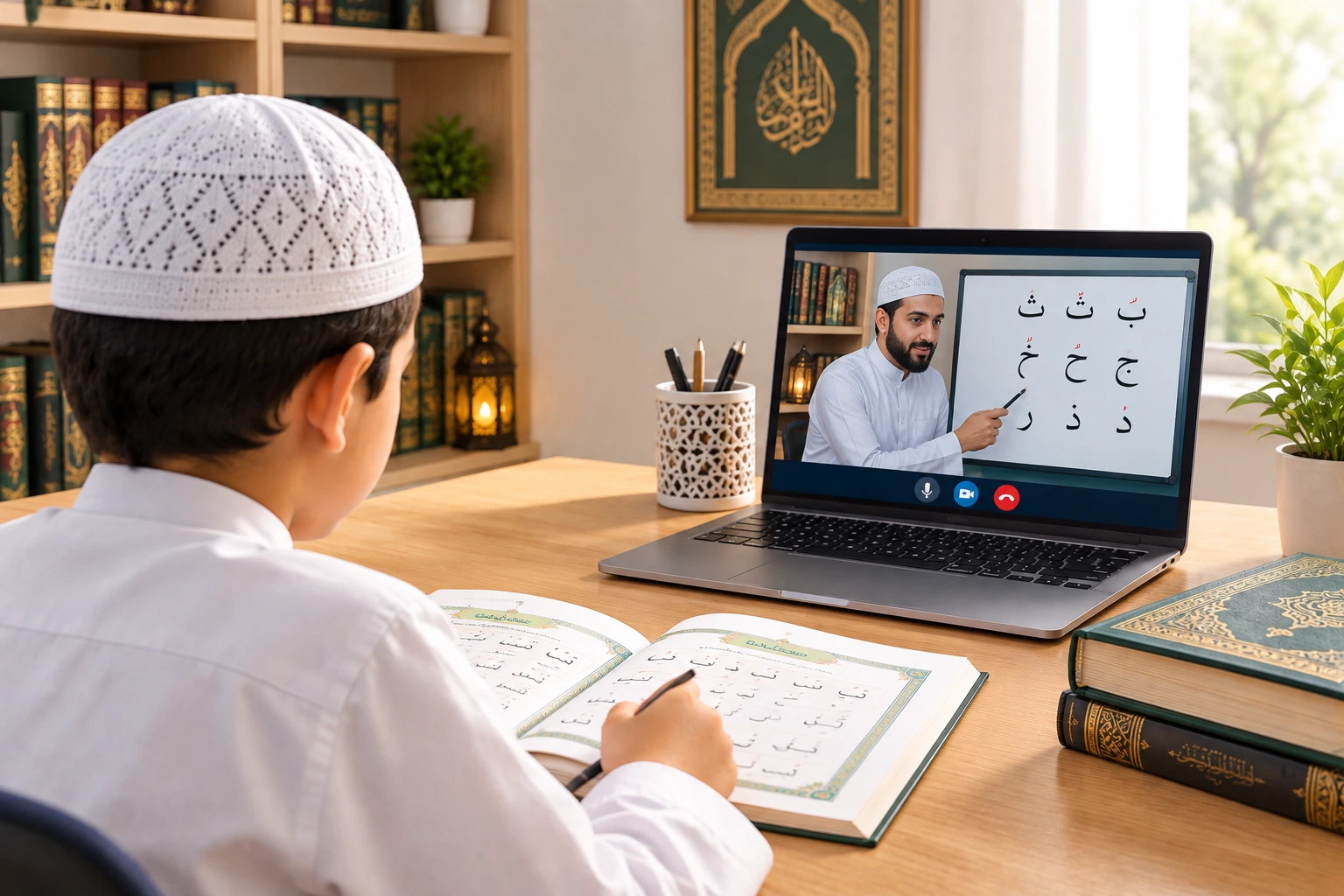
Teaching Islamic civilization can connect faith learning with history, geography and culture. Children can explore the Prophet’s life, shared worship, changing political communities and contributions to learning and trade. A timeline helps distinguish the seventh-century beginnings from later developments.
The source sometimes portrayed many regions and centuries as one unified empire. Islamic civilization is a broader historical category, involving different states, peoples, languages and experiences. Shared religious ideals did not mean every government or society always acted identically.
Table of Contents
- Place the Beginnings on a Timeline
- The Prophet Muhammad’s Life and Teaching
- The Five Pillars
- Early Caliphates and Their Different Periods
- Quran, Hadith and Guiding Values
- Expansion and the Spread of Faith
- Sharia and Governance
- Festivals and Observances
- Daily Life and Social Roles
- Women’s Contributions
- Frequently Asked Questions
Place the Beginnings on a Timeline
The source located the beginnings in the seventh century, with revelation around 610 CE. Expansion later reached North Africa and Spain in the west and regions towards Sindh in the east. Avoid treating “India” as if the whole modern country was incorporated into one early state.
Baghdad, founded in 762, and Córdoba became important centres in different political settings; Cairo belongs to later developments rather than the first Muslim community. The Metropolitan Museum’s Abbasid account helps place Baghdad’s foundation and later political fragmentation in context.
Discuss science, mathematics, art and trade as developments involving diverse contributors. A professional course can support this topic, but examine the actual curriculum and sources rather than assuming all tutors are historians.
The Prophet Muhammad’s Life and Teaching
The source used approximately 570 CE for his birth in Makkah, 610 for the beginning of revelation and 622 for the Hijrah to Madinah. These dates provide a basic teaching sequence. The Hijrah is the epoch associated with the Islamic calendar.
Introduce mercy, honesty, justice, charity and community responsibility through reliable accounts. Separate a historical event from a later moral lesson drawn from it. The early community’s growth involved challenges as well as cooperation.
The Five Pillars
| Pillar | Child-appropriate introduction |
|---|---|
| Shahada | Faith in Allah alone and Muhammad as His Messenger. |
| Salah | The five daily prayers. |
| Zakat | An obligation concerning eligible wealth and recipients, distinct from all voluntary charity. |
| Sawm | Ramadan fasting with its applicable conditions. |
| Hajj | Pilgrimage to Makkah for those able to undertake it. |
These shared practices help explain religious life, while daily details differ according to circumstance and legal guidance. Do not present a historical description as an instruction that every young child must undertake each adult obligation immediately.
Early Caliphates and Their Different Periods
| Period used in the source | Dates | Historical focus |
|---|---|---|
| Rashidun | 632–661 CE | Leadership and territorial expansion after the Prophet’s death. |
| Umayyad | 661–750 CE | Expansion across regions including North Africa, Iberia and Sindh. |
| Abbasid, centred on Baghdad | 750–1258 CE | Learning, cultural patronage and trade, alongside changing political control. |
The source linked these periods with education and prosperity. Explain that achievements developed over time and were not uniform across all territories. Córdoba’s later importance should not be collapsed into an Abbasid capital story.
Quran, Hadith and Guiding Values
The Quran and reports of the Prophet’s words, actions and approvals inform Islamic teaching. The source cited 2:43 on prayer and zakat, and the praise of good manners found in Bukhari 3559.
Use these references to discuss ideals and responsibilities. Historical conduct still needs evidence; a community’s religious ideals do not prove that every ruler acted fairly.
Expansion and the Spread of Faith
The source named Umar and Uthman in early expansion and listed entry into Spain in 711, the Battle of Tours in 732 and the Abbasid transition in 750. Keep these as timeline markers, not a complete account of global Islam.
Military conquest, trade, migration, learning and agreements contributed differently across regions. Conversion was not the same process as political conquest. The source’s description of exclusively peaceful spread, and its claim that Tours halted all further expansion into Europe, are overly broad.
Sharia and Governance
Discuss Islamic principles of justice, charity, honest trade and respect. Legal interpretation and governance developed through scholarly and political histories; Sharia should not be reduced to one timeless administrative code imposed identically everywhere.
The source claimed it ensured equal treatment and harmonious government. Those are ideals to examine, not proof that every historical arrangement achieved them. Age-appropriate history can recognise diversity and injustice without abandoning the discussion of values.
Festivals and Observances
| Source observance | Focus | Calendar placement |
|---|---|---|
| Eid al-Fitr | End of Ramadan fasting. | Beginning of Shawwal; civil dates vary. |
| Eid al-Adha | Sacrifice and the account of Ibrahim. | Dhul-Hijjah; civil dates vary. |
| Mawlid | Commemoration of the Prophet’s birth in communities that observe it. | Often associated with Rabi al-Awwal; practice and legal views differ. |
| Islamic New Year | Beginning of the Hijri year. | Muharram; observance differs. |
| Laylat al-Qadr | A night of special devotional significance. | Sought in Ramadan’s last ten nights, not an ordinary festival with one certain universal date. |
Do not imply that every later cultural observance was practised in the same way from the earliest period. Discuss both shared worship and regional variation.
Daily Life and Social Roles
The source described traders, farmers and artisans, with mosques serving worship, learning and community functions. Family, cleanliness, honesty and mutual care were important teaching themes. Actual life also varied by location, occupation, status and century.
Women participated in family life, scholarship and business, with other public roles in particular contexts. Avoid reducing their history to a single uniform experience.
Women’s Contributions
The source highlighted Khadijah’s business and support in the earliest community, Aishah’s scholarship, Fatimah’s kindness and charity, and Nusaybah bint Ka’b’s courage in battle accounts. Use reliable biographies to explore the specific evidence and context for each.
Its saying attributed to Al-Hakim about taking half of religion from Aishah lacks a precise authenticated reference here. Her scholarly role should not depend on asserting that unverified quotation as a prophetic statement.
Ask for an age-appropriate Islamic history syllabus with reliable references and clear explanations. Connect historical events with the child's broader Islamic learning, and check how the teacher distinguishes evidence from interpretation. Related guidance: children’s Islamic studies, the education overview, course information.
 Talqeen Academy
is a globally recognized platform for learning the Quran, Arabic,
and Islamic Studies through personalized one-on-one online sessions with expert tutors.