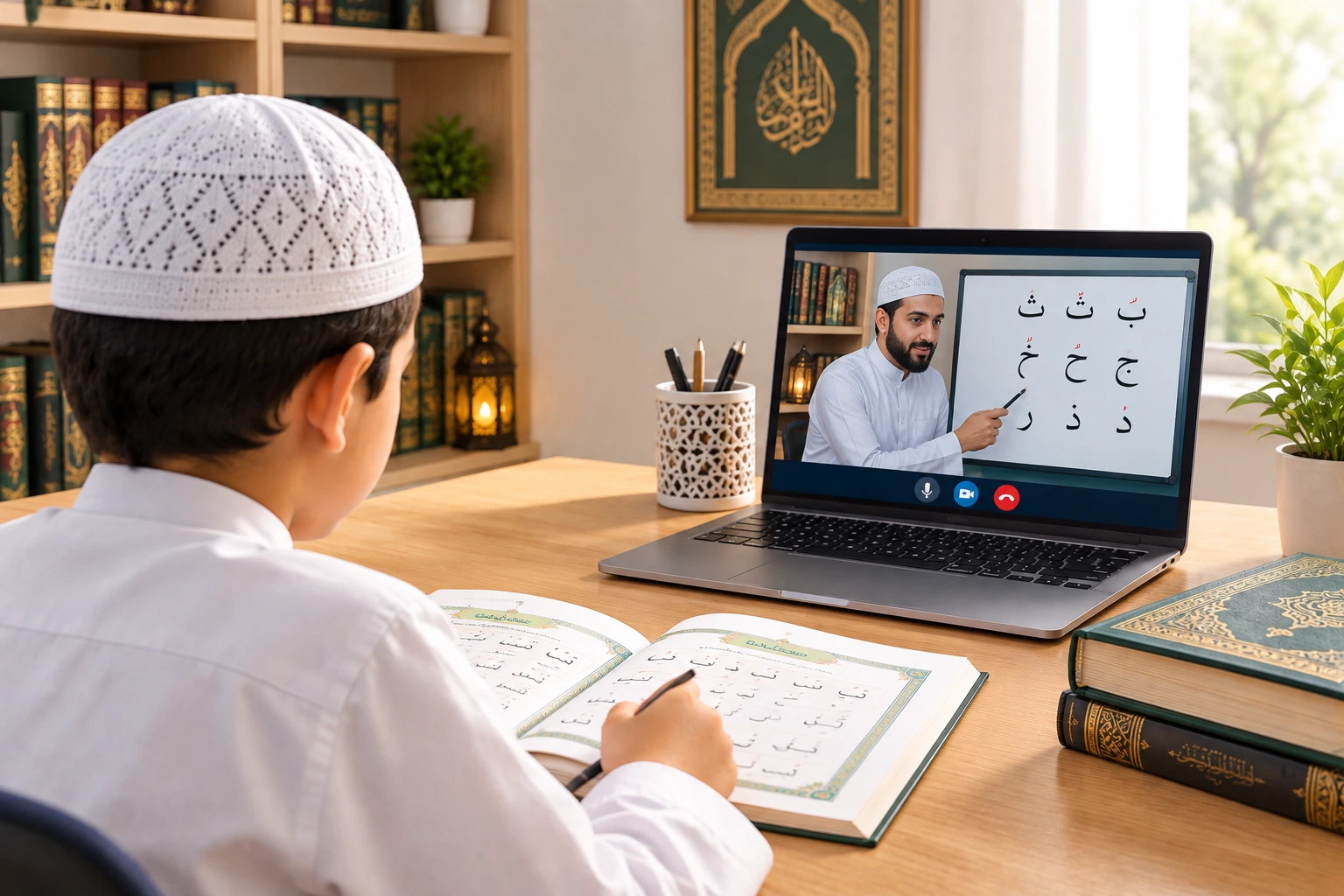
Children can learn that Muslim communities have different histories, practices and interpretations while being taught to treat people respectfully. A clear lesson distinguishes describing beliefs from endorsing every belief or judging a particular person's spiritual outcome.
The source advertised a children's Islamic studies course covering Quran, Tajweed, Arabic, fiqh, Hadith, aqidah and tafsir. This article retains its seven labels and ten teaching points while correcting an inaccurate classification.
Table of Contents
Why Learn about These Differences?
Historical understanding can reduce confusion when children encounter different community practices. Teaching can encourage empathy, careful questions and recognition of shared beliefs without minimising significant disagreements.
Do not describe all differences as merely slight. Explain difficult topics at a suitable level and avoid turning children into judges of other families.
The Source's Division Report
The original quoted Ibn Majah 3992, attributed to Awf ibn Malik. It mentions seventy-one divisions among Jews, seventy-two among Christians and seventy-three in the Prophet's nation, with one saved group described as al-jamaah. The linked edition grades it hasan.
This report is not a modern population chart or evidence that seven labels in an internet list map directly to its divisions. A qualified teacher should explain its context rather than use it to threaten classmates or assign named individuals to Hell.
Seven Labels from the Source
1. Sunni
Sunni Islam is the largest broad tradition. It draws on Quran, Sunnah and scholarly methods, including discussion of consensus. Hanafi, Maliki, Shafii and Hanbali are legal schools within Sunni learning, not four separate religions.
The source estimated Sunnis at eighty-five to ninety percent. Pew's 2009 demographic report used eighty-seven to ninety percent. These are dated estimates, not a newly measured 2026 count.
2. Sufi Traditions
Sufism concerns spiritual training and devotional traditions. The source emphasised dhikr, love and tolerance and named Qadiriyya, Naqshbandiyya, Chishtiyya and Mevleviyya orders.
It is misleading to put all Sufis outside Sunni or Shia identity: these affiliations can overlap. Orders also differ, so no single short description establishes every teaching or practice.
3. Wahhabi and Salafi Labels
The source connected Wahhabism with Muhammad ibn Abd al-Wahhab and an eighteenth-century Arabian movement, stressing tawhid. It described Salafism more broadly as seeking the example of the early generations.
These labels are related in some contexts but are not interchangeable descriptions of every individual. “Literal interpretation” alone is too simplistic to explain different approaches to evidence and scholarship.
4. Shia Traditions
Questions of leadership after the Prophet and the position of Ali are central to Shia historical identity. The source named Twelvers, Zaydis and Ismailis and noted commemoration of Husayn's death at Ashura.
Explain each tradition in its own terms without suggesting all practices are identical. The source's separate Ismaili entry belongs within this broader category.
5. Ibadi
The source identified Oman and emphasised justice and governance. Ibadism has an early history and its own scholarly tradition; it should not be reduced to a midpoint between Sunni and Shia.
Its assertion that Ibadism simply predates both traditions was not established. Labels such as “moderate” or “conservative” need context rather than serve as objective facts about every believer.
6. Ahmadiyya
The source connected the movement with Mirza Ghulam Ahmad in late-nineteenth-century India. The movement's own website describes claims concerning its founder that mainstream Muslim interpretations reject in relation to the finality of Muhammad's prophethood.
This is a substantial doctrinal disagreement, not merely a different prayer custom. The source also mentioned persecution and education, missionary work and peace as movement themes. Explain disagreement without justifying mistreatment or treating one short label as a full account of every branch.
7. Ismaili
Ismailis form a Shia branch connected historically with the succession associated with Ismail ibn Jafar. The source stressed education, community service and intellectual learning.
Official Ismaili guidance identifies Prince Rahim Aga Khan V as the fiftieth imam. Specify the Nizari community when discussing Aga Khan leadership rather than implying that every Ismaili branch has the same leader.
A Corrected Overview Table
| Source label | Classification | Topics to explain | Example geographical connections |
|---|---|---|---|
| Sunni | A broad Islamic tradition; its legal schools are not separate equivalent sects | Quran, Sunnah and recognised scholarly methods | Communities across the Middle East, Asia, Africa and elsewhere |
| Sufi | Spiritual traditions and orders that can overlap Sunni or Shia identity | Dhikr, devotion and spiritual training; practices vary | Examples in Turkey, South Asia and the Middle East |
| Wahhabi / Salafi | Related but non-identical reform labels, not one uniform group | Emphasis on tawhid and the early Muslim generations | Historical links with Arabia; also wider communities |
| Shia | A broad tradition with several branches | Imamate and Ali’s leadership are central historical topics | Communities in Iran, Iraq, Lebanon, Pakistan and elsewhere |
| Ibadi | A distinct early Islamic tradition | Its own scholarly history and approaches to community leadership | Especially Oman, with other communities including East Africa |
| Ahmadiyya | A movement originating with Mirza Ghulam Ahmad in nineteenth-century India | Claims about its founder conflict with mainstream understandings of final prophethood | Communities in South Asia, Africa, Europe and elsewhere |
| Ismaili | A branch within Shia Islam, not a separate category alongside all Shia | Different branches and leadership traditions; education and service are source themes | Communities in Central Asia, East Africa, Canada and elsewhere |
The table retains the source's geographical examples without claiming that these places contain only one tradition or that the list is an exhaustive map.
Ten Introductory Learning Points
- Broad traditions: Sunni and Shia are major categories; they do not cover every historical community label.
- The name Sunni: it is associated with Sunnah, prophetic guidance and example.
- Population: use a dated source for demographic estimates instead of a timeless exact percentage.
- Early leadership: Sunni accounts recognise Abu Bakr as the first caliph, while succession is a central historical disagreement.
- Legal schools: learn the names Hanafi, Maliki, Shafii and Hanbali without presenting them as mutually separate faiths.
- Worship: prayer, Ramadan fasting, Zakat and Hajj are major duties with relevant conditions.
- Imams: a Sunni prayer leader has a different role from an ordained priest; appropriate prayer-leading qualifications still matter.
- Hadith: prophetic reports include sayings, actions and approvals and require informed study.
- Eid: Eid al-Fitr and Eid al-Adha provide contexts for prayer, family gatherings, food and appropriate celebration.
- Respect: unity, kindness and careful disagreement should guide conduct; do not pretend all theological questions are settled by a classroom slogan.
Choosing Children's Islamic Studies
The source's eight-course list comprised Quran, Islamic studies, Arabic, Tajweed, tafsir, aqidah, fiqh and Hadith. It also described memorization with recitation rules, vocabulary for Quran understanding, prophetic learning and foundational beliefs.
Its marketing claimed native-Arab experts, around-the-clock lessons, games, quizzes, multimedia, affordable packages and either individual or small-group formats. These claims require verification and are not confirmed Talqeen features.
Look for suitable explanations, qualified subject knowledge, reasonable scheduling and room for respectful questions. Consult course information, beginner foundations and Islamic education.
 Talqeen Academy
is a globally recognized platform for learning the Quran, Arabic,
and Islamic Studies through personalized one-on-one online sessions with expert tutors.