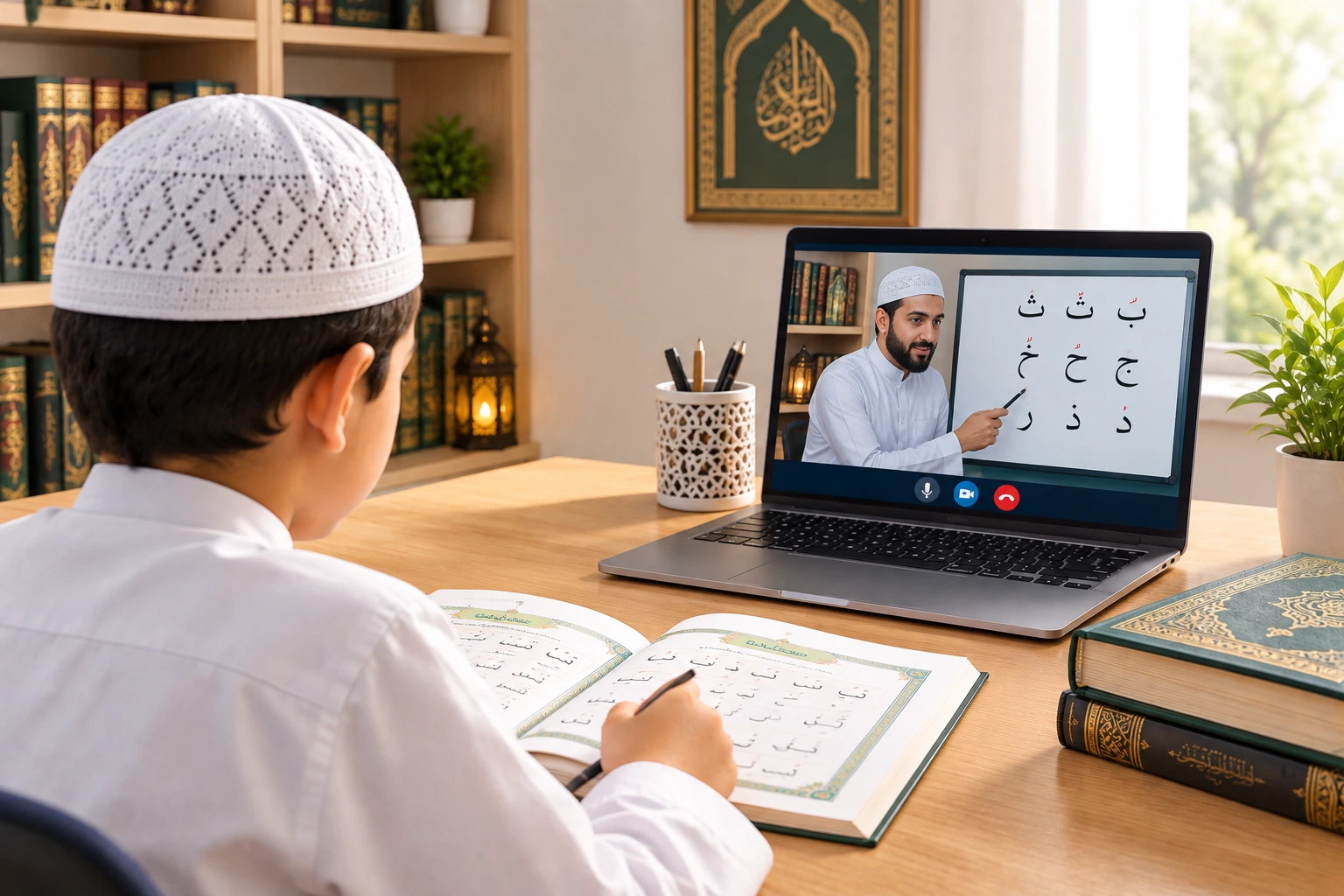
Teaching the Quran to children begins with a relationship: the child learns what study feels like through the adult's patience, attention and example. Early practice can introduce sounds, familiar words and short passages, while more structured lessons develop as the child becomes ready.
Parents sometimes struggle to select materials, explain pronunciation or keep lessons consistent. The following eight approaches retain the practical ideas in the source while distinguishing suggested activities from universal developmental milestones. A child who needs more time should receive support rather than pressure to match another learner.
Table of Contents
- 1. Build Reading Skills with a Suitable Qaida
- 2. Introduce Quran Stories with Accurate References
- 3. Correct with Patience and Tolerance
- 4. Distinguish General Supplications from Quranic Duas
- 5. Keep Daily Lessons within the Child's Capacity
- 6. Evaluate Learning Apps before Using Them
- 7. Read Together as a Family
- 8. Choose a Teacher Who Fits the Learning Need
- When Should Children Begin?
- Frequently Asked Questions
1. Build Reading Skills with a Suitable Qaida
A Qaida is one useful route into Arabic reading. Choose a version that the teacher knows well and work through its progression carefully. Completing pages quickly is less useful than recognising their patterns when they appear in unfamiliar words.
- Learn Arabic letters, their shapes and their sounds.
- Practise the vowel marks, or harakat, and how they change a sound.
- Recognise joined letters in different positions within words.
- Introduce the recitation rules appropriate to the child's current level.
Ask the learner to identify a letter, hear a model and try a short example. When a sound remains difficult, return to an easier exercise and seek qualified correction. A parent can support practice without taking responsibility for rules they have not mastered. See the children's Quran learning guide for a broader progression.
2. Introduce Quran Stories with Accurate References
Stories can make a discussion concrete: children can ask what happened, what a person chose and what lesson the passage teaches. Read the relevant verses or a reliable explanation first. Use language the child understands, and identify any explanatory detail that comes from a commentary rather than the Quran itself.
| Prophet | Story focus | Quran reference |
|---|---|---|
| Adam | Creation and the account involving the Garden | 2:30–39 |
| Nuh | The ark and the flood | 11:25–49 |
| Ibrahim | The test involving his son | 37:100–111 |
| Musa | The journey through the sea | 20:77–79 |
These references preserve the examples supplied in the original article. They are starting passages, not necessarily complete biographies. Invite a question or a brief retelling; avoid adding dramatic details merely to entertain. Connecting a story with kindness, trust or perseverance can help a child discuss its meaning without turning it into a test of perfect recall.
3. Correct with Patience and Tolerance
Children differ in attention, confidence and reading experience. A difficult lesson does not establish laziness or lack of ability. Give one clear correction at a time, model the sound and let the child attempt it again. Celebrate care and persistence as well as correct answers.
The source linked patient instruction to children's psychology without identifying a particular study. The practical recommendation stands on its own: keep correction respectful and observe what helps this learner. If repeated frustration occurs, reduce the task and discuss the obstacle with the teacher. Online classes may offer useful structure or scheduling flexibility, but confirm the actual format before enrolling.
4. Distinguish General Supplications from Quranic Duas
The original section described the following seven prayers as Quranic duas. These formulations are not Quran verses. They are retained here as the general supplications presented by the source; this list does not establish a particular hadith attribution or prescribe them as a fixed devotional sequence.
- اللَّهُمَّ أَدْخِلْ عَلَى أَهْلِ القُبُورِ السُّرُورَ — O Allah, bring joy to the people of the graves.
- اللَّهُمَّ أَغْنِ كُلَّ فَقِيرٍ — O Allah, free every poor person from need.
- اللَّهُمَّ أَشْبِعْ كُلَّ جَائِعٍ — O Allah, satisfy every hungry person.
- اللَّهُمَّ اكْسُ كُلَّ عُرْيَانٍ — O Allah, clothe everyone who lacks clothing.
- اللَّهُمَّ اقْضِ دَيْنَ كُلِّ مَدِينٍ — O Allah, settle the debt of every debtor.
- اللَّهُمَّ فَرِّجْ عَنْ كُلِّ مَكْرُوبٍ — O Allah, relieve everyone in distress.
- اللَّهُمَّ رُدَّ كُلَّ غَرِيبٍ — O Allah, return every absent traveller home.
Explain the meaning before asking for repetition. These requests can prompt age-appropriate discussion of hunger, clothing, debt and concern for others. For an explicitly Quranic example, introduce the prayer for increased knowledge in 20:114. Keep its verse attribution distinct from the general formulations above.
5. Keep Daily Lessons within the Child's Capacity
A short, manageable session can include a familiar dua, a few letters or a portion of a short surah. The source suggested Al-Fil and Al-Ikhlas from Juz Amma as examples. Choose the actual passage according to reading readiness and the teacher's sequence rather than assuming every short chapter is equally easy.
Agree on a small task, review what was learned and stop before practice becomes a prolonged struggle. When concentration varies, adapt the activity instead of treating the clock as the measure of success. Track accurate recall and willingness to return, with no deadline imposed simply to keep pace with other children.
6. Evaluate Learning Apps before Using Them
The source named Muslim Kids TV for stories, games and activities; a Noorani Qaida app for initial reading; Quran Companion for reward-based practice; and Ayat Al Quran for reading and listening. These are retained as examples to investigate, without asserting current availability, features or suitability.
Several apps use similar Qaida or Ayat names, so identify the exact product and publisher. Preview content, advertisements, permissions, account requirements and privacy settings. Check that the recitation and exercises agree with the teacher's method. An engaging interface can support a lesson, but it cannot confirm that the child's pronunciation is accurate.
7. Read Together as a Family
Let the child hear regular, calm reading at home. During a shared session, take turns with a manageable passage and discuss a simple meaning. Model returning to study even when progress is gradual; the adult does not need to present an image of effortless perfection.
Correct only what you can explain reliably, and record questions for the teacher when necessary. Keep comparisons between siblings out of the session. Family reading provides an opportunity for attention and discussion, though improved relationships or memorisation should not be promised as automatic outcomes.
8. Choose a Teacher Who Fits the Learning Need
A useful tutor should be able to explain the child's present level and what comes next. During an introductory conversation or lesson, assess the following:
- Instruction adapted to the child's current skills.
- Competent pronunciation and Tajweed correction.
- Achievable goals that can be reviewed.
- A workable, consistent lesson schedule.
- Clear feedback and respectful encouragement.
Ask how parents receive updates and how the teacher handles mistakes, tiredness or reluctance. For a fuller selection checklist, read choosing a Quran teacher. Confirm the relevant course details directly through the course page.
When Should Children Begin?
The source suggested simple duas around age two, Qaida around three to four and short Juz Amma passages around five to six, including Al-Fil and Al-Ikhlas. Treat these ages as illustrative possibilities, not required milestones or evidence of a single best starting age. Eating and bedtime can provide familiar occasions for a brief supplication when the child is receptive.
Readiness includes interest, communication needs and the ability to participate comfortably. Older beginners can also make progress. Build the learning plan around the actual child, with a teacher who adjusts the activities and pace accordingly.
 Talqeen Academy
is a globally recognized platform for learning the Quran, Arabic,
and Islamic Studies through personalized one-on-one online sessions with expert tutors.