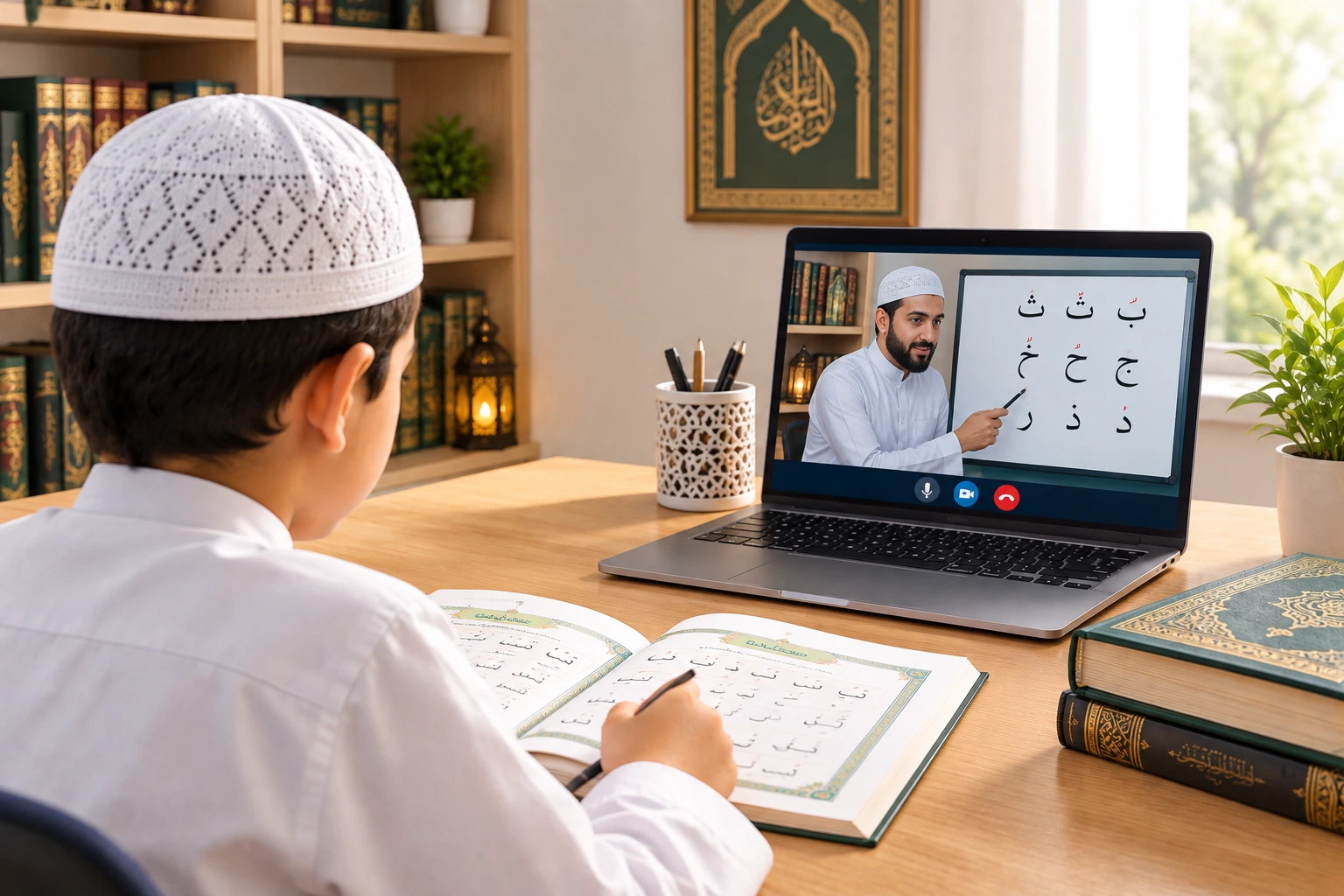
An autistic child should be approached as an individual learner, with their own communication, interests, sensory preferences and starting skills. A Quran lesson may involve listening, recognising a letter, choosing a symbol or reading a short passage. Spoken memorisation is not the only way to participate meaningfully.
The original guide proposed eight teaching tips and discussed learning ability and Surah Al-Ikhlas. Those subjects are retained here while correcting generalisations and unsupported treatment claims. Quran education can be adapted respectfully; it should not be promoted as a cure for autism or as a guaranteed way to improve speech.
Table of Contents
- 1. Choose Visual Materials That Help This Child
- 2. Offer Familiar Recitation Without Pressure
- 3. Use Clear, Comfortable Communication
- 4. Make the Routine Predictable and Adaptable
- 5. Introduce Short Supplications Appropriately
- 6. Do Not Require Eye Contact as Proof of Attention
- 7. Use Gestures and Encouragement That Are Welcome
- 8. Recognise Progress Without Coercion
- Can an Autistic Child Learn the Quran?
- Does Surah Al-Ikhlas Treat Autism?
- Choose a Teacher Through Actual Experience
- Frequently Asked Questions
1. Choose Visual Materials That Help This Child
A Qaida may introduce letters and sounds, but its suitability depends on the learner. The source suggested colourful pictures, a first-chapter letter exercise and short pronunciation videos. Some children may find a simple layout easier than a bright or busy page.
Use meaningful symbols or printed words that the child recognises. NICE guidance emphasises individual communication and environmental adjustments, including meaningful visual support and attention to sensory sensitivities. It does not establish that all autistic children learn best through the same visual-and-audio combination.
Introduce one manageable element, allow time to respond and notice whether the material is helping. A primer is a resource to adapt, not an obligation to complete every exercise on a fixed timetable.
2. Offer Familiar Recitation Without Pressure
The source suggested a parent reading Al-Fatihah and showing الْحَمْدُ لِلَّهِ رَبِّ الْعَالَمِينَ, the wording of 1:2. This can provide an opportunity to connect sound and text when the child is comfortable with it.
Keep the amount and volume suitable, and allow listening or another response instead of demanding immediate imitation. Repetition may increase familiarity, but should not be described as guaranteeing recognition or accurate recitation. Observe the child's engagement and preferences.
3. Use Clear, Comfortable Communication
The source recommended a low, soft voice because loud instruction may be overwhelming. Some children have particular sound sensitivities, while others need a different volume or communication format. Ask the family what is comfortable rather than assume whispering is always best.
Give a clear instruction and time to process it. Avoid a rapid stream of explanations, harsh correction or increasing volume when a response is delayed. A calm lesson should preserve the child's ability to indicate discomfort or ask for a break.
4. Make the Routine Predictable and Adaptable
A familiar space and a clear start and finish may help organise participation. The source suggested a quiet corner or study area, with after-Fajr or after-Asr sessions. Its clock examples of 6 am and 4 pm are not universal prayer times or evidence of when every child is most alert.
Choose an appointment that fits the child's actual routine. Explain changes using the communication support that works for them. Predictability should not become rigidity that forces a lesson during distress or tiredness.
The original text repeated this routine advice twice. The practical content is consolidated here, with the same emphasis on an appropriate time and familiar environment rather than presenting repetition as an additional teaching method.
5. Introduce Short Supplications Appropriately
The source offered اللَّهُمَّ اغْفِرْ لِي, asking Allah for forgiveness, and رَبِّ زِدْنِي عِلْمًا, from 20:114. The first is a general supplication; the second is Quranic wording. Keep that distinction clear.
A brief phrase may be suitable for a listening, recognition or recitation activity. Use the child's established way of responding rather than assume they must speak to demonstrate attention. Teach the meaning simply and avoid using a religious exercise as a speech-treatment promise.
6. Do Not Require Eye Contact as Proof of Attention
The source advised limited eye contact and warned that sustained looking may be uncomfortable. A better practical rule is to avoid requiring eye contact at all as a condition of learning. A child may attend while looking at the page, a symbol or elsewhere.
Notice response through their communication and the task, rather than a particular gaze. The source's broad scientific explanation about overstimulation was not supported by a cited study and should not be assumed to describe every child identically.
7. Use Gestures and Encouragement That Are Welcome
Smiles, nods, gestures and simple visual cues were source suggestions for clear guidance. Choose those that the child understands and welcomes. A dramatic expression, sudden applause or excited noise may be uncomfortable for some learners.
Keep feedback specific: recognise the attempt, clarify the next step and allow a pause. Do not force touch or a particular social response. Coordinate with the family and the child's existing educational support so that instructions and communication remain familiar.
8. Recognise Progress Without Coercion
The source suggested playtime, a preferred snack or a sticker chart after a small assessment. If recognition is used, agree on a suitable approach with the family and make the task achievable. A child's basic needs, access to communication or necessary breaks should not depend on completing recitation.
Assessment may involve recognising a letter, indicating the next item or attempting a short sound, depending on the goal. Avoid making every session a test of memorisation. Progress should be described in terms of the child's actual participation and skill.
Can an Autistic Child Learn the Quran?
Autistic children can participate in Quran learning, but their goals, communication and rate of progress vary. The source described strong memory as a scientific characteristic of autistic children. It did not establish that generalisation, and a memorisation strength should not be assumed for every learner.
Assess interests and skills individually. Some children may enjoy precise repetition, others may prefer a short story or visual activity. The teacher should adapt the lesson without treating a different response as disobedience or lack of faith.
Does Surah Al-Ikhlas Treat Autism?
The source claimed that Al-Ikhlas has been shown to improve self-monitoring, speech clarity and communication. It did not provide adequate evidence for those clinical claims. The surah can be studied as part of religious education when suitable, but should not be advertised as an autism treatment.
A familiar recitation may be enjoyable or meaningful to a child without proving a medical effect. Educational and health support should continue according to the child's assessed needs. Keep religious learning complementary to that support rather than a replacement for it.
Choose a Teacher Through Actual Experience
Ask about experience adapting lessons, communication preferences, sensory adjustments and collaboration with families. A trial should show respectful pacing and a willingness to change the task. General Quran qualifications do not automatically establish expertise supporting every autistic learner.
Discuss the child's communication, sensory and learning needs before arranging lessons. Ask about the teacher's relevant experience, possible adjustments and the family's role, and use a gradual trial to assess whether the arrangement is comfortable and suitable. Related guidance: the course page, gradual children's learning.
 Talqeen Academy
is a globally recognized platform for learning the Quran, Arabic,
and Islamic Studies through personalized one-on-one online sessions with expert tutors.