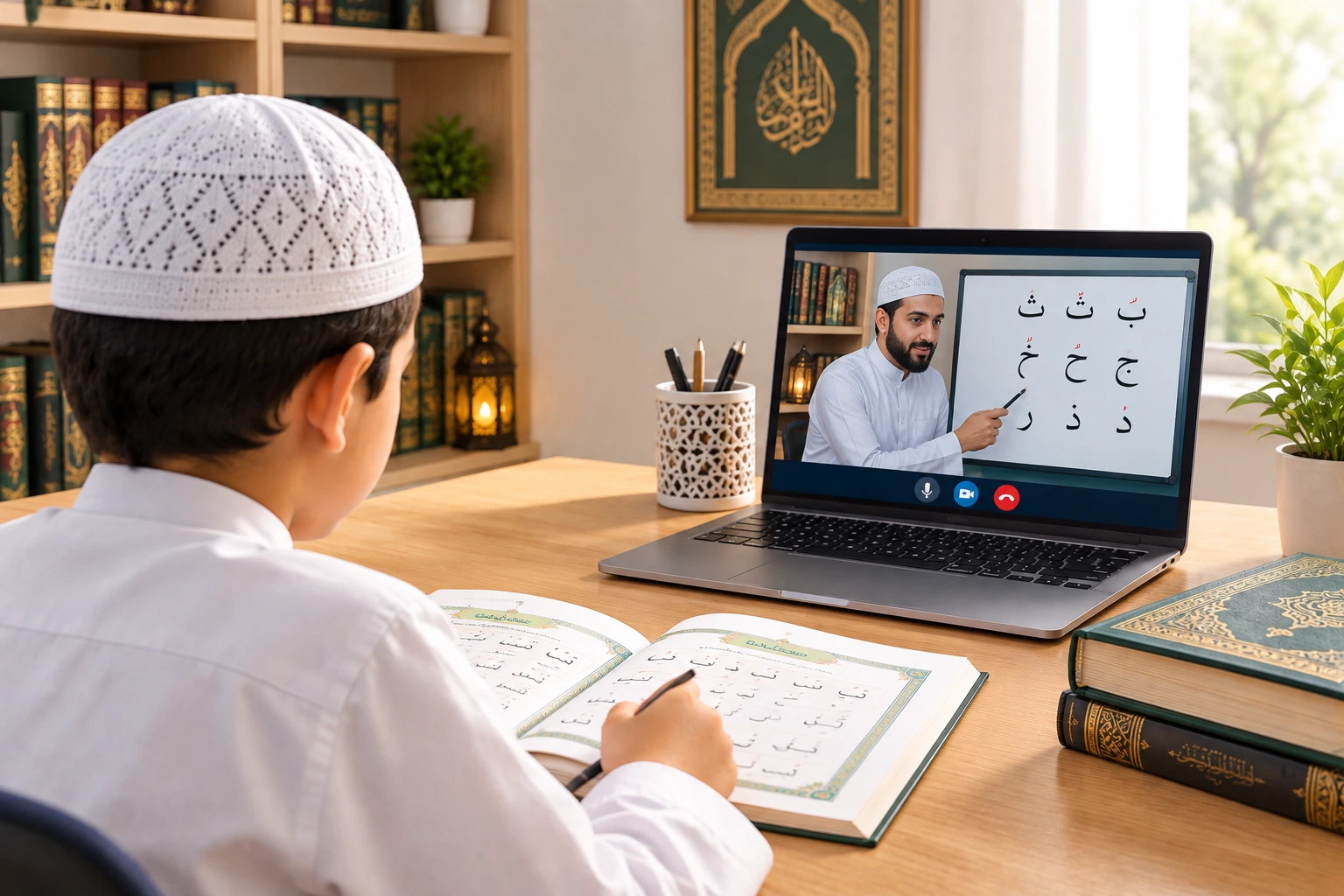
Hifz readiness is more than reaching a particular birthday. Parents can observe reading skills, comfort with a short routine, interest and the ability to learn a manageable passage. These observations guide a discussion with a teacher; they are not a diagnostic test or a fixed pass-or-fail checklist.
The source listed eight signs and several home exercises. It treated some repetition counts and attention spans as proof of readiness. Keep those as examples while recognising that children differ and may need adapted teaching, communication or support.
Table of Contents
- 1. Short Surahs Can Be Read with Increasing Independence
- 2. Letter Sounds Respond to Guided Practice
- 3. Basic Recitation Cues Are Becoming Familiar
- 4. A Small Passage Can Be Recalled Later
- 5. A Short Session Is Comfortable
- 6. Correction Can Be Given Respectfully
- 7. A Small Home Routine Is Feasible
- 8. Small Tasks Are Completed with Support
- Age Ranges and Their Limits
- A Gentle Home Check before Enrolment
- Frequently Asked Questions
1. Short Surahs Can Be Read with Increasing Independence
The source suggested Al-Ikhlas or Al-Falaq, read daily for a week, to observe fewer pauses and improving flow. Use an unfamiliar or carefully checked passage too: fluent repetition of a familiar surah may reflect memory rather than independent word reading.
If small words remain difficult, strengthen reading gently before increasing memorisation demands. Some children learn familiar short passages by listening while developing script skills; a formal programme should assess how both needs will be supported.
2. Letter Sounds Respond to Guided Practice
The source highlighted ayn, ghayn, qaf and kha: ع، غ، ق، خ. Model one sound and invite an attempt, with qualified feedback where necessary. Correct wording and pronunciation matter before repeated memorisation.
Its claim that correction within one or two tries proves readiness is too absolute. Some sounds take longer, and difficulty may call for tailored instruction rather than exclusion. A parent should not certify articulation beyond their own competence.
3. Basic Recitation Cues Are Becoming Familiar
The source’s three-symbol table included an inaccurate description of a small meem as a light merge. Symbols vary between editions and context matters.
| Source cue | Correct learning point |
|---|---|
| Madd mark, approximately ~ | Identify the lengthening rule and its required duration with a teacher; not merely a “short moment.” |
| Small meem near noon or tanween before ba | An iqlab cue in relevant editions, involving conversion to a meem sound with nasalisation, not simple idgham. |
| Meem used as a stop mark | Distinguish the stopping symbol and its function in that edition from the small iqlab mark. |
The Quran Academy iqlab lesson explains the noon or tanween context. Recognition should be paired with an assessed reading attempt, not treated as proof of complete Tajweed.
4. A Small Passage Can Be Recalled Later
The source suggested two or three lines, or one ayah repeated ten to twelve times, followed by independent recitation. That can be a small informal exercise if it suits the child, but immediate recall alone does not establish long-term readiness.
Check again after a short delay and, as the source proposed, about an hour later or later in the day. Use a portion the child reads accurately. Forgetting calls for review and adjustment; it does not necessarily mean the child must be kept out of all structured learning.
5. A Short Session Is Comfortable
Fifteen to twenty minutes was the source example, possibly split into two ten-minute sessions. A shorter or differently structured lesson may suit the child. Sitting still is not the only way to participate attentively.
The source predicted that most children naturally adjust within weeks. That outcome is not established here. Observe fatigue, engagement and accurate performance, and discuss adaptations with the teacher.
6. Correction Can Be Given Respectfully
A learner needs opportunities to hear feedback and try again. A child becoming upset does not automatically lack readiness; the correction style, task difficulty and prior experience may need attention.
Offer one clear correction, recognise effort and pause when necessary. A calm adult response can support learning without demanding that children never show frustration.
7. A Small Home Routine Is Feasible
The source suggested one surah for review, one line for reading and a short listening task. Another example was five minutes each of reading, listening and revision. Adjust the amounts rather than making fifteen minutes a compulsory routine.
Parents can provide reminders appropriate to age. Needing support is not proof that a child cannot attend a class. Discuss how the teacher and family will share responsibility for practice.
8. Small Tasks Are Completed with Support
Careful homework or regular reading may suggest that a routine is possible. It does not guarantee future Hifz success. Give clear, manageable tasks and observe what prompts or help the child needs.
Consistency develops through a workable plan, not through judging a child’s honesty or worth by how quickly a task is finished. Keep progress visible without comparing siblings.
Age Ranges and Their Limits
The source suggested stronger readiness at nine to twelve and possible starts at six to eight. These are source generalisations without evidence establishing one best range. Younger or older children may be ready for different formats.
A teacher should assess reading, recall, interest, communication and required support. See children’s practice methods and course-path comparison.
A Gentle Home Check before Enrolment
Choose one accurate short ayah, model it, repeat as needed and invite recall. The source’s ten-to-twelve repetitions and later one-hour check are examples, not a scientifically validated test. Two lines may be tried when manageable.
Build a short reading, listening and review habit with calm reminders and a comfortable space. Ten daily minutes may be a starting point, but readiness differs. Ask how the teacher will assess your child's participation and adjust the workload. Related guidance: course information.
 Talqeen Academy
is a globally recognized platform for learning the Quran, Arabic,
and Islamic Studies through personalized one-on-one online sessions with expert tutors.