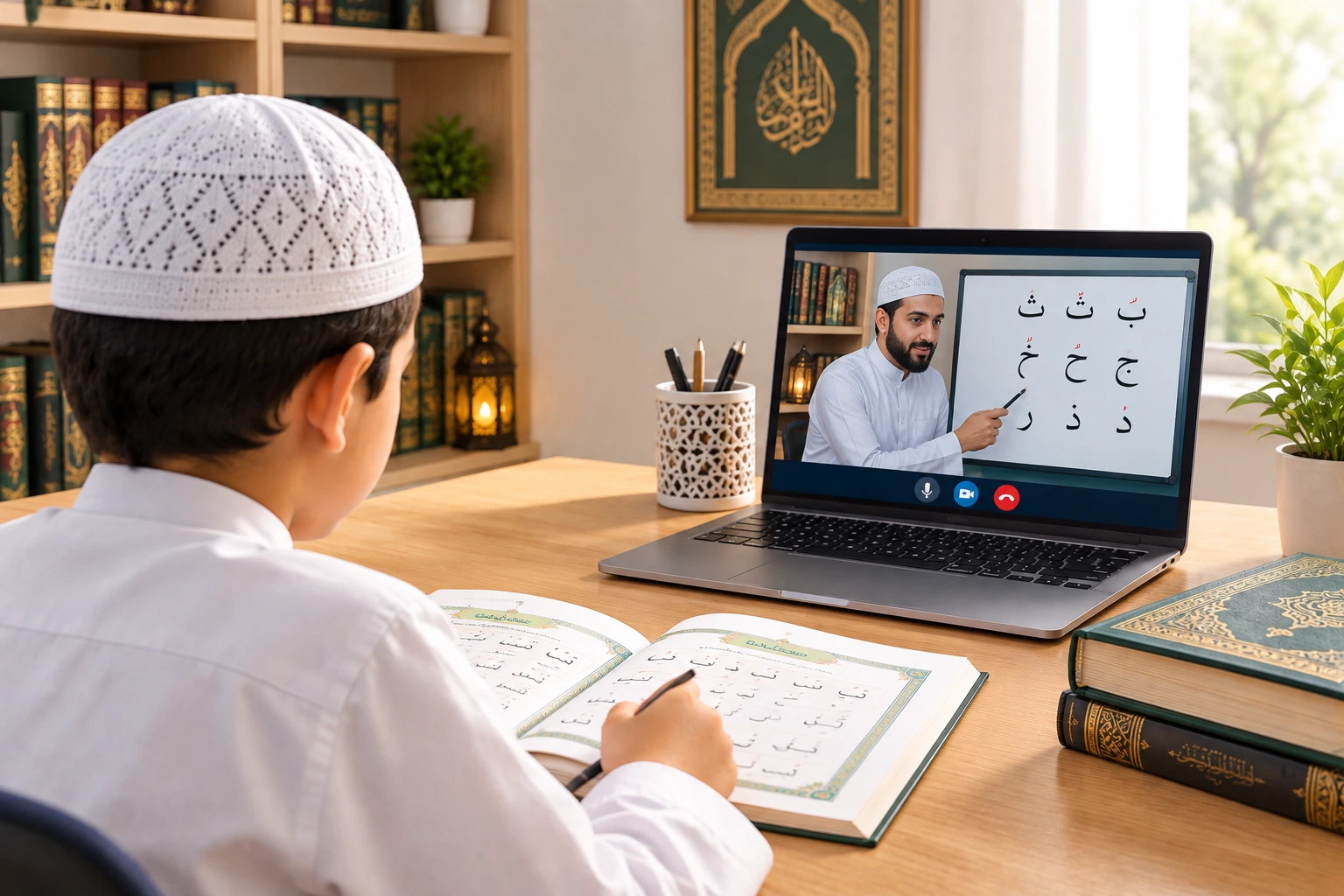
Children can learn the Quran very well online, but the best format for a six-year-old is not the best one for a twelve-year-old. This guide focuses on choosing the right path for your child: which course, how long each lesson should be and what a good children's lesson looks like.
For the parent's own role at home, including setup and safety, see what parents should know.
Table of Contents
Start with the goal, not the course name
| Your goal for the child | Good starting point |
|---|---|
| Learn to read Arabic letters and words | Quran reading, with a gentle, play-based start |
| Read the Quran fluently and correctly | Quran reading, then Tajweed |
| Memorise short surahs first | Reading basics together with short surah memorisation (see Juz Amma revision) |
| Become a Hafiz | Strong reading foundation first, then Hifz |
| Understand Islamic basics | Islamic Studies for children |
Choosing the class length
Younger children tire quickly. Talqeen Academy's 30-minute class is designed for ages 4 to 8 and for short revision sessions, while 45 minutes is the most popular length for older children who can focus for longer. As a rule, choose the shorter option and extend only when the child asks for more.
What a good children's lesson looks like
- Starts with a friendly greeting and a quick recap of last time.
- Mixes activities: listening, repeating, a letter game, short reading.
- Gives specific encouragement ("You pronounced that letter perfectly").
- Ends with a small, clear task for the week.
If your child is silent for most of the lesson or seems anxious, the pace or style is not right and it is worth raising with the teacher.
How many lessons per week?
Two or three short lessons a week plus a few minutes of practice on other days suits most children. One weekly lesson can work for older children who practise independently, but progress is usually slower for beginners because so much fades between lessons.
Matching teacher and child
Look for patience, warmth and the ability to explain things simply. Qualifications matter too: ask whether the teacher is a native Arabic speaker and what training they have in teaching children. A free trial lesson is the best test; watch whether your child relaxes.
Keeping children engaged over months
- Use a visible progress chart.
- Let the child choose between two activities in practice.
- Connect lessons to real life: reading aloud in the family or reciting in prayer.
- Revisit favourite surahs so they feel successful.
More ideas are in the guide to interactive lessons and motivation tips.
Frequently asked questions
Continue your learning with Online Quran Courses for Kids: Eight Study Paths Explained, How to Teach Quran for Kids: A Practical Parent Guide, Helping Kids Learn Quran and Arabic Online: A Parent’s Guide.
 Talqeen Academy
is a globally recognized platform for learning the Quran, Arabic,
and Islamic Studies through personalized one-on-one online sessions with expert tutors.