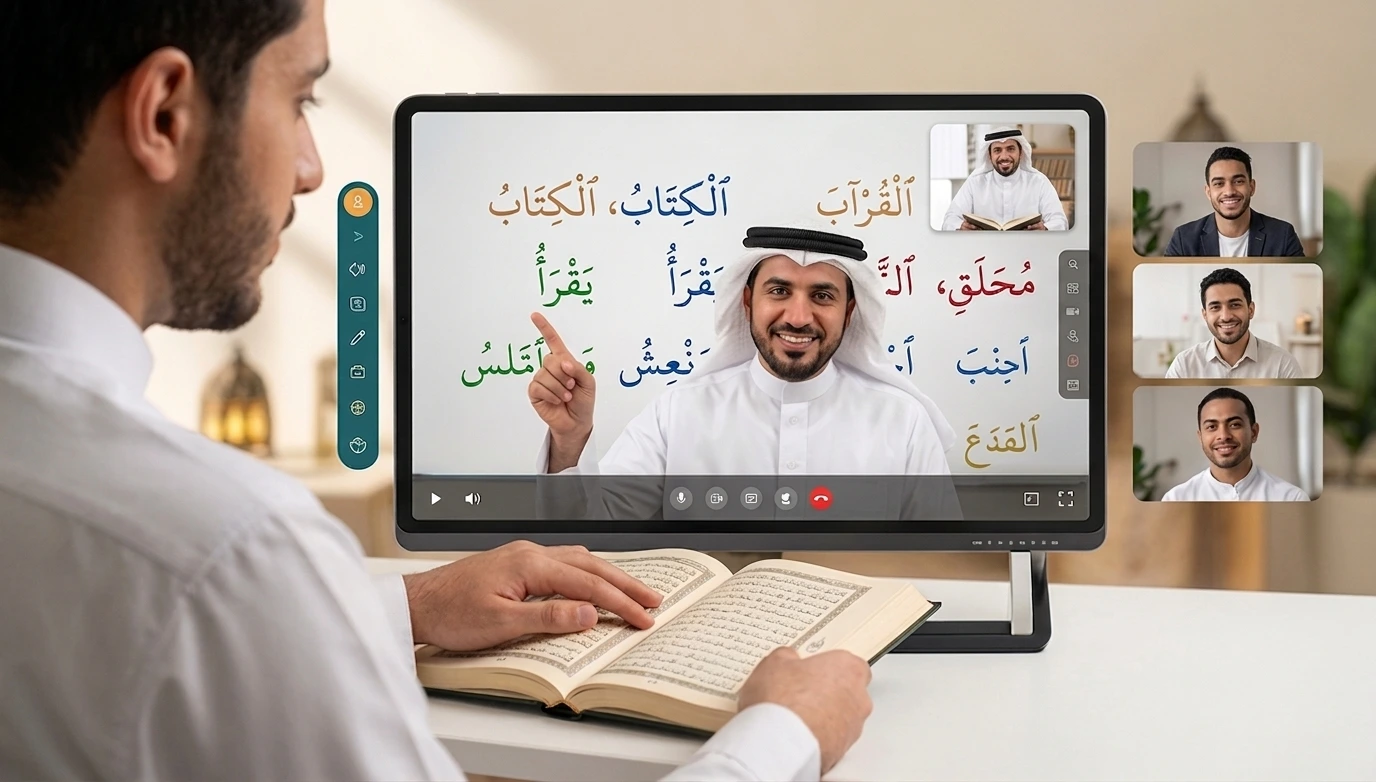
A video call can easily become a one-way broadcast: the teacher talks, the student nods. Quran learning does not work that way. Recitation is a skill, and skills are built by doing, being heard and being corrected.
These techniques make a lesson active. Some are for the teacher to use; many are things a student or parent can ask for.
Table of Contents
Start with a short warm-up
Open the lesson by having the student recite the previous assignment without prompting. This tells the teacher what stuck and tells the student what they can already do. It also moves the student from listening mode to active mode in the first two minutes.
Echo reading and call-and-response
The teacher recites a short phrase and the student repeats it immediately, keeping the same rhythm and sounds. This builds accurate pronunciation faster than reading alone. For longer verses, break them into short chunks and join them back together.
Use the shared screen
- The teacher can highlight the letter or word being corrected so the student sees exactly where the problem is.
- Colour-coded text can show Tajweed rules visually, such as where a madd is stretched or a ghunnah is applied.
- For beginners, the teacher can build a word letter by letter on screen so the student sees how letters join.
The student can ask for the screen to be shared again after the lesson to review what was marked.
Ask the student to teach back
Asking "Can you explain how you know to stretch that letter?" turns passive learning into understanding. Even young children can show a younger sibling or a parent one thing they learned. If they can explain it, they know it.
Record and replay
With the teacher's agreement, the student can record themselves reading a short passage at the start and end of the month. Hearing the difference is powerful motivation. Between lessons, a quick voice memo of today's corrected lines lets the student compare with the reciter.
Make it playful for children
- Letter-sound games: the teacher says a sound, the child points to the letter.
- Find-the-mistake: the teacher reads a line with one deliberate error and the child catches it.
- Short stories connecting a surah to its meaning in simple words.
- A visible progress chart the child fills in after each lesson.
Keep activities brief. Younger children do best with several short tasks rather than one long one, which is also why 30-minute classes suit ages 4 to 8.
For adults: ask why
Adults often learn best when they understand reasons: why a letter is pronounced from a certain point in the mouth, why a rule applies. A good teacher welcomes these questions because they lead to lasting accuracy, not just imitation.
How to prepare as a student
- Have the previous assignment ready to recite.
- Bring one or two questions written down.
- Keep the camera angled so the teacher can see your face; mouth movement is part of correcting pronunciation.
- Mute other devices and sit where you will not be interrupted.
Frequently asked questions
Continue your learning with How to Make Time for Quran Learning in Adulthood, How to Make the Shahada: Words, Meaning and First-Month Guidance, How to Make Time for Quran Study as an Adult: 10 Practical Tips.
 Talqeen Academy
is a globally recognized platform for learning the Quran, Arabic,
and Islamic Studies through personalized one-on-one online sessions with expert tutors.