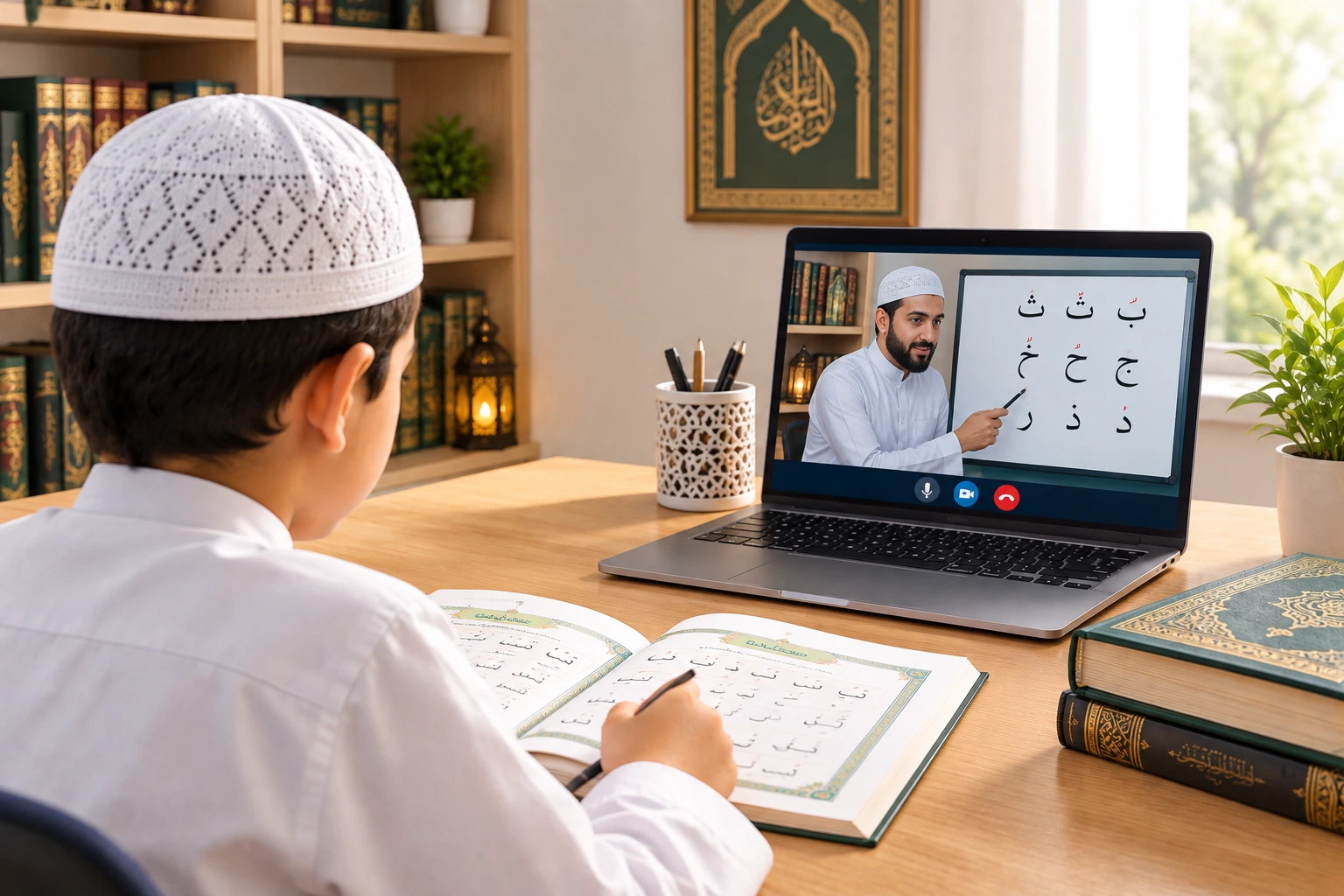
The right online Quran course depends on a child’s present skills and learning goal. Initial reading, memorisation and understanding are different tasks; an advanced certification route should not be presented as the next step for every beginner.
The eight course categories below offer a framework for comparing children's Quran learning needs. Check the actual syllabus, entry level, assessment, reporting and teaching arrangements before choosing a course.
Table of Contents
1. Initial Quran Classes
The source described personalised lessons for ages three to fifteen, using games and activities to introduce Arabic letters, pronunciation and fluent reading. That age range is the provider’s claim, not proof that every three-year-old is ready for a formal class.
Ask whether the syllabus covers accurate articulation, basic recitation rules, increasing reading fluency and a suitable introduction to Hifz. Confirm how the instructor adapts activities and reports progress. Enjoyable activities can support participation without guaranteeing freedom from boredom or effortless reading.
2. Islamic Studies for Children
The source included beliefs, manners, daily duas, prophetic stories, hadith, Salah, truthfulness and respect. It also listed Seerah and character development as outcomes. Ask how material is referenced and explained for the child’s age.
Stories, games and discussion can make the lesson accessible, while family example gives values a practical setting. No course guarantees a particular character outcome. See Islamic studies and character learning.
3. Introductory Tajweed
Begin with the rules and sounds the child is ready to apply. The source suggested mirror-assisted articulation, identifying rules in Quran passages, personalised correction and frequent lesson practice. A mirror may show lip position but cannot reveal or verify every articulation point.
Ask the teacher to demonstrate and listen, rather than relying on rule names or visual exercises. Secure recitation can be revisited in prayer with appropriate guidance, while separate sessions permit detailed correction.
4. Quran Recitation Development
This route suits learners who already read basic Arabic and need greater accuracy and fluency. The source listed clear recitation, application of foundational rules, tutor audio feedback and individual guidance.
Ask what the entry assessment checks and how errors are tracked. A pleasant voice is not a substitute for correct wording. Confidence can grow through respectful practice without being a guaranteed course result.
5. Hifz for Children
A memorisation programme should include accurate initial reading, new portions and a growing revision rotation. The source said parents could select the first surah or juz and described repetition, visual aids and tests. Selection should also reflect a teacher’s assessment.
Additional advertised features were mind maps before sessions, digital progress reports, surah stories or infographics, and monthly evaluations. Confirm which are actually supplied and whether explanations remain accurate. Mind maps and multimedia do not replace exact-word recall.
See Hifz readiness before choosing an intensive programme.
6. Quranic Arabic
A language course can introduce frequent vocabulary, grammar and sentence patterns. The source proposed understanding common Quranic words, recognising structural rules, translating basic sentences and building a foundation for further study.
Distinguish an introductory classroom exercise from independently interpreting a verse. Reliable tafsir and context remain important. A recitation teacher and a language teacher need the competence relevant to their respective subjects.
7. Advanced Tajweed
The source targeted children with an established foundation and advertised deeper rule study, correction of recurring errors, assessments and application in longer passages. Ask what “advanced” means in the actual syllabus.
Repeated practice and individual feedback can refine skills, but no course should guarantee flawless application. Advancement should depend on observed reading rather than age or completion of a fixed number of lessons.
8. Ijazah Study
An ijazah is an authorisation with a particular scope and requirements; it is not simply any course completion certificate. The source described one-to-one study with authorised scholars, full-Quran review, detailed feedback and preparation for recitation or Hifz authorisation.
It also claimed a transmission chain reaching the Prophet. Verify the actual teacher’s authorisation, reading or narration studied, assessment requirements and the document offered. Not every advertised certificate establishes such a chain, and completion cannot be guaranteed before assessment.
Assess the Teaching Arrangements
The source’s reasons for choosing its provider were individual attention, interactive multimedia, regular parent reports, flexible scheduling and free trial lessons. Preserve these as features to ask about rather than unverified Talqeen commitments.
- How is the child’s starting level assessed?
- What individual feedback follows a lesson?
- How do parents receive progress information?
- What scheduling and rescheduling options actually apply?
- Is a trial offered, and what are its terms?
Confirm teacher competence, privacy and the child’s response to the actual lesson. A programme may aim to foster love of the Quran, but it cannot promise lifelong attachment or success for every child. Explore course information and teacher-selection guidance.
 Talqeen Academy
is a globally recognized platform for learning the Quran, Arabic,
and Islamic Studies through personalized one-on-one online sessions with expert tutors.