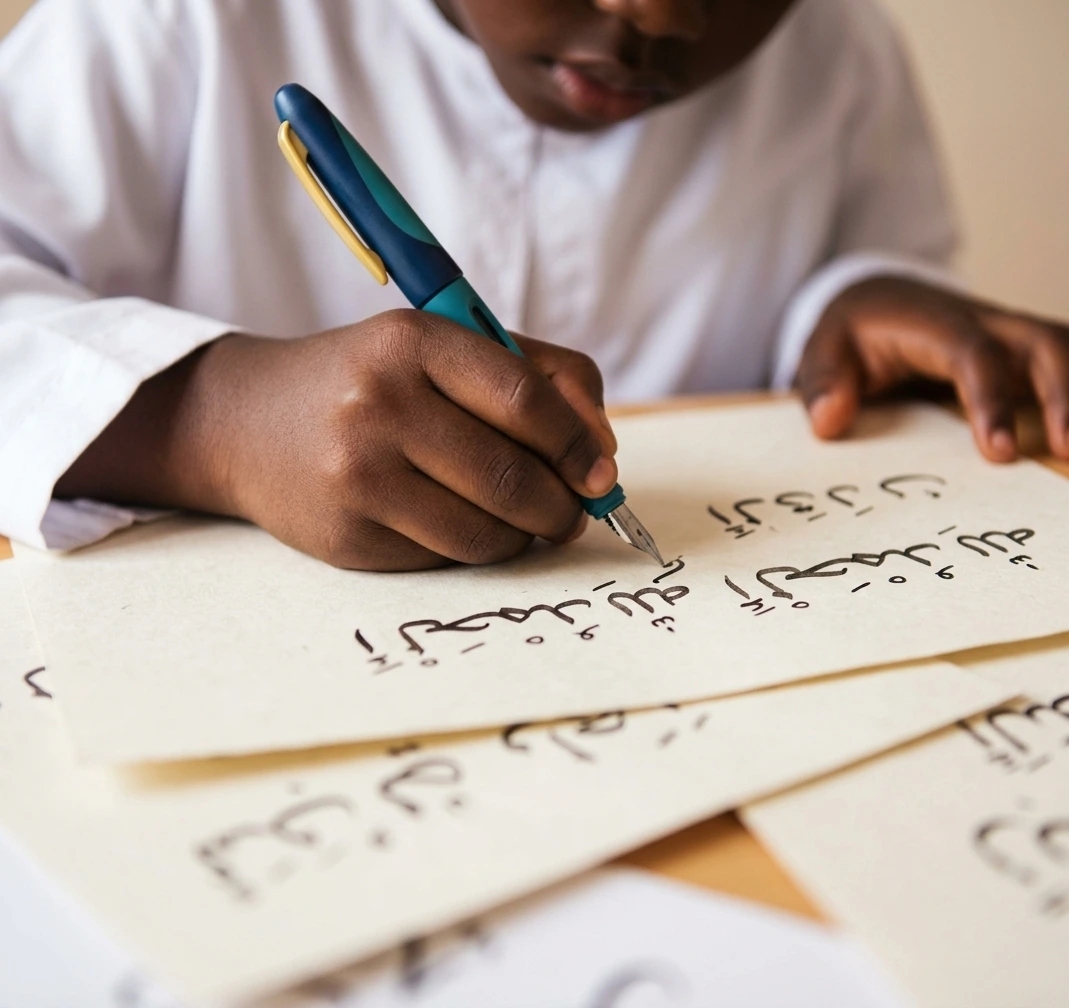
Arabic can be exciting for children when lessons connect with activities they understand and enjoy. Difficulty or slow progress does not mean a child cannot learn; it can signal that the task, pace or support needs adjustment.
Parents can encourage curiosity, organise home practice and celebrate improvement. A balanced plan combines structured teaching with games, stories and meaningful uses of the language.
Table of Contents
Make Parental Support Visible
Show a positive interest in the child's work and offer a safe place to practise imperfectly. Listen, ask what they learned and recognise a specific improvement. Support is more helpful than comparing their pace with another child's.
Parents need not be fluent Arabic speakers. They can follow teacher instructions, organise resources and ask for help with uncertain sounds or grammar.
Create an Inviting Home Environment
A small learning area, Arabic labels or decorations and suitable listening material can make the language familiar. Use simple Arabic at home where you can do so correctly. The source also suggested Arabic music and nursery rhymes; choose material appropriate to your family's preferences and the learning goal.
A welcoming setting supports participation without requiring the whole home to become a classroom. Leave room for ordinary play and rest.
Set Goals that Fit the Child
Choose a modest goal together: recognising several words, using a short phrase or applying a grammar pattern. Celebrate secure learning and revise a target when it causes repeated frustration.
Challenge should follow readiness. An attainable goal gives the learner a reason to return, while a rigid demand for quick fluency may undermine confidence.
Use Interactive Activities
Arabic-themed board games or suitable digital games can connect language with choices and turns. Use a known word or sentence in the activity, rather than relying on entertainment alone to teach it.
Songs and rhymes may introduce sound patterns. Storytelling, role-play, practical projects and supervised workshops can provide opportunities to speak and respond. A virtual class can include those activities when the teacher plans them deliberately.
The source's uncredited quotation said enjoyable engagement is the best route to learning. Enjoyment can help motivation, but effective instruction also needs a clear goal, correction and review.
What to Look for in Online Classes
Check the teacher's experience with children, the curriculum, technical setup and the amount of actual language practice. Vocabulary, grammar and speaking should develop through suitable tasks rather than a stream of disconnected games.
The original provider claimed age-appropriate levels, live lessons, interactive multimedia, regular feedback and progress reports. Those descriptions belong to its advertisement and require checking. They are not verified Talqeen services.
Ask how the course includes cultural understanding and how progress is assessed. Consult actual course information and use an available trial to observe the lesson.
Explore Media Carefully
Apps Named in the Source
The source listed Baraem, Lamsa and Arabico, describing games, stories, songs, conversation and personalised learning. Their names are retained as source examples, not a current verification of app identity, availability or features.
Before choosing an app, check its exact publisher, Arabic variety, age suitability and actual activities. Use it for a defined task and ask the teacher whether the content supports the course.
Channels Named in the Source
| Source example | Claimed content to verify |
|---|---|
| Learn Arabic with Maha | Vocabulary, grammar and conversation lessons |
| Aram Academy | Alphabet and word-building activities |
| Kids Learning Arabic | Rhymes, songs and introductory stories |
These labels do not guarantee that a channel is current, uniquely identifiable or suitable for every child. Preview the specific video and distinguish adult-language lessons from material designed for young learners.
Shows and Films
Arabic-language stories and familiar characters may motivate listening. Choose suitable content and check whether it uses the variety being studied. Briefly revisit a phrase afterwards so viewing includes active learning.
Connect Language with Culture
Explore the diverse customs, art and traditions of Arabic-speaking communities. Cooking can introduce words for ingredients and actions. The source suggested tagines and baklava; these foods have regional and wider cultural histories rather than representing one uniform Arab culture.
Eid al-Fitr can offer a setting for greetings and community vocabulary. The source also named Mawlid events; their observance varies and is disputed among Muslims, so participation is not a universal religious requirement.
Stories can introduce literature in age-appropriate form. The source named The Thousand and One Nights and Naguib Mahfouz. Unabridged works may contain mature material; select appropriate adaptations or simpler children's books rather than assuming all classics suit young readers.
The original included an image-description passage featuring flashcards, tablets, Arabic letters and cultural objects in a virtual classroom. Those ideas can inform visual learning resources, but an image description is not evidence of a real programme's features.
Keep Interest Sustainable
Combine predictable lessons with enjoyable activities, recognise small wins and remain patient during slow periods. Family participation can make learning meaningful while allowing the child to develop their own confidence.
Arabic can support communication and appreciation of cultural diversity. Read parent support guidance and play-based Arabic learning for related practice ideas.
 Talqeen Academy
is a globally recognized platform for learning the Quran, Arabic,
and Islamic Studies through personalized one-on-one online sessions with expert tutors.