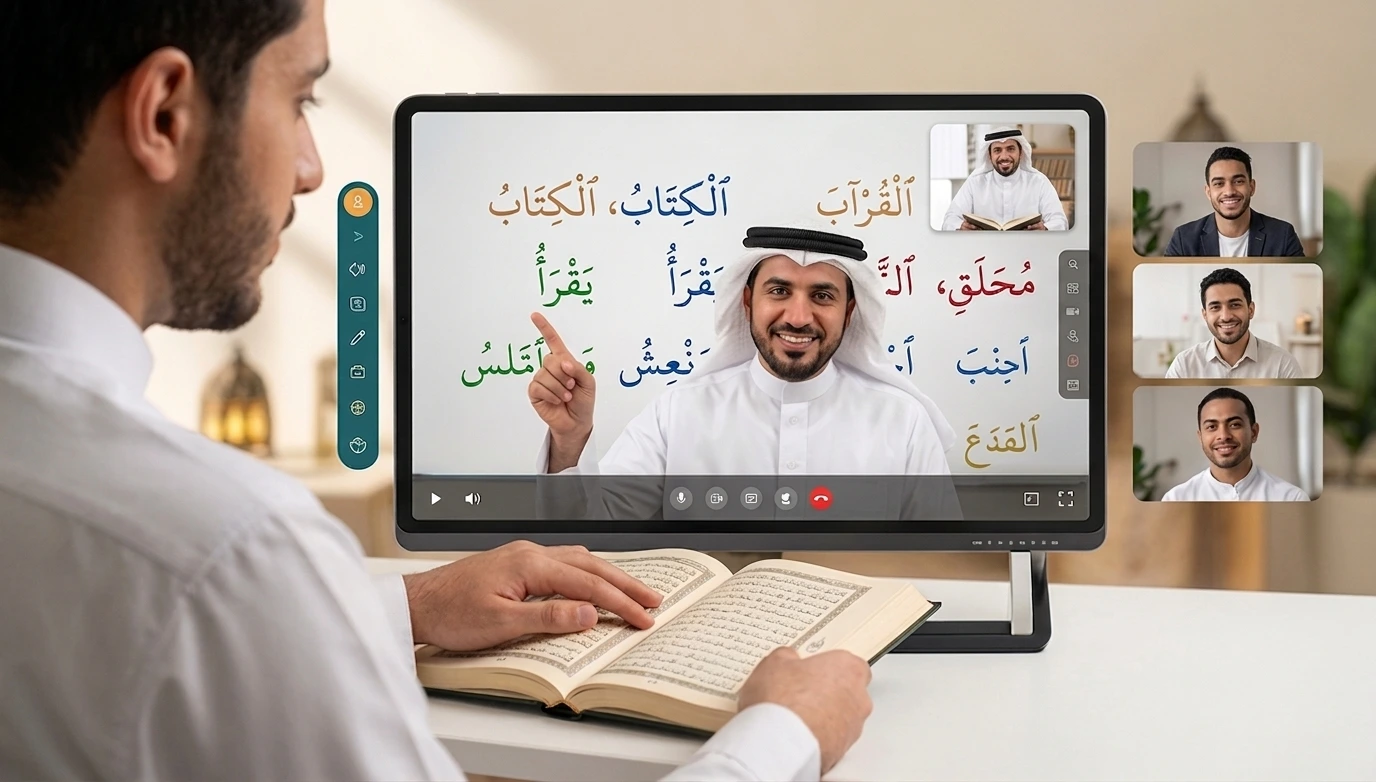
If you or your child cannot yet read Arabic, learning to read the Quran can look like a mountain. It is much easier when you see it as a sequence of stages, each building on the last.
Below is a typical path for a complete beginner. The speed at which people move through it varies a lot, so use it as a map, not a calendar.
Table of Contents
Stage 0: Set the goal and check the starting point
The first lesson should answer two questions: what does the student want to be able to do, and what can they already do? A short level check lets the teacher choose the right starting point rather than assuming.
Stage 1: Letters and sounds
The Arabic alphabet has 28 letters. At Talqeen Academy the teaching follows the Noor Al-Bayan approach: all 28 letters are taught with fatha first, before any other vowel. This builds a clear sound foundation without introducing too many new symbols at once. See the Noor Al-Bayan course.
- Learn each letter by sound, then by shape.
- Practise recognising letters in different positions in a word.
- Listen as much as you read; the sound is the point.
Ready to move on when: the student can identify any letter and say its sound without hesitation.
Stage 2: Vowels and signs
Next come the other short vowels, then sukoon, shaddah, tanween and the long vowels (madd). Each is introduced with plenty of practice before the next.
Ready to move on when: the student can read single syllables and short words with all the common signs correctly.
Stage 3: Joining letters and reading words
Arabic letters change shape when joined. This stage trains the eye to see the same letter in its different forms and the mind to read connected words smoothly.
Ready to move on when: the student reads a line of connected text without sounding out each letter.
Stage 4: Short surahs
Reading real surahs is a major motivational boost. Students typically begin with Al-Fatiha and short surahs from Juz Amma, which they may already know by ear. See easy surahs to start with.
Ready to move on when: the student reads these surahs independently with accurate pronunciation.
Stage 5: Introduction to Tajweed
Once the reading is stable, basic Tajweed rules refine it: the points of articulation, elongation, noon sakinah and others. Tajweed lessons can begin alongside Stage 4 or follow it.
Stage 6: Fluent Mushaf reading
The student reads page after page of the Mushaf with growing speed and accuracy, and the teacher focuses on polishing. Many students want to start Hifz, Arabic or Islamic Studies from here.
Staying on track
- Move on when a stage is mastered, not when a number of weeks has passed.
- Practise a little every day. The home practice plan shows how.
- Track the stages you complete using the progress guide.
- Be patient. Children, adults and new Muslims all progress at different speeds, and that is normal.
Frequently asked questions
Continue your learning with Beginner-Friendly Quran Courses for New Muslims in the UK, Where to Start Reading the Quran: A Beginner Learning Roadmap, How to Learn to Read Quran in Arabic: Letters, Practice and Support.
 Talqeen Academy
is a globally recognized platform for learning the Quran, Arabic,
and Islamic Studies through personalized one-on-one online sessions with expert tutors.