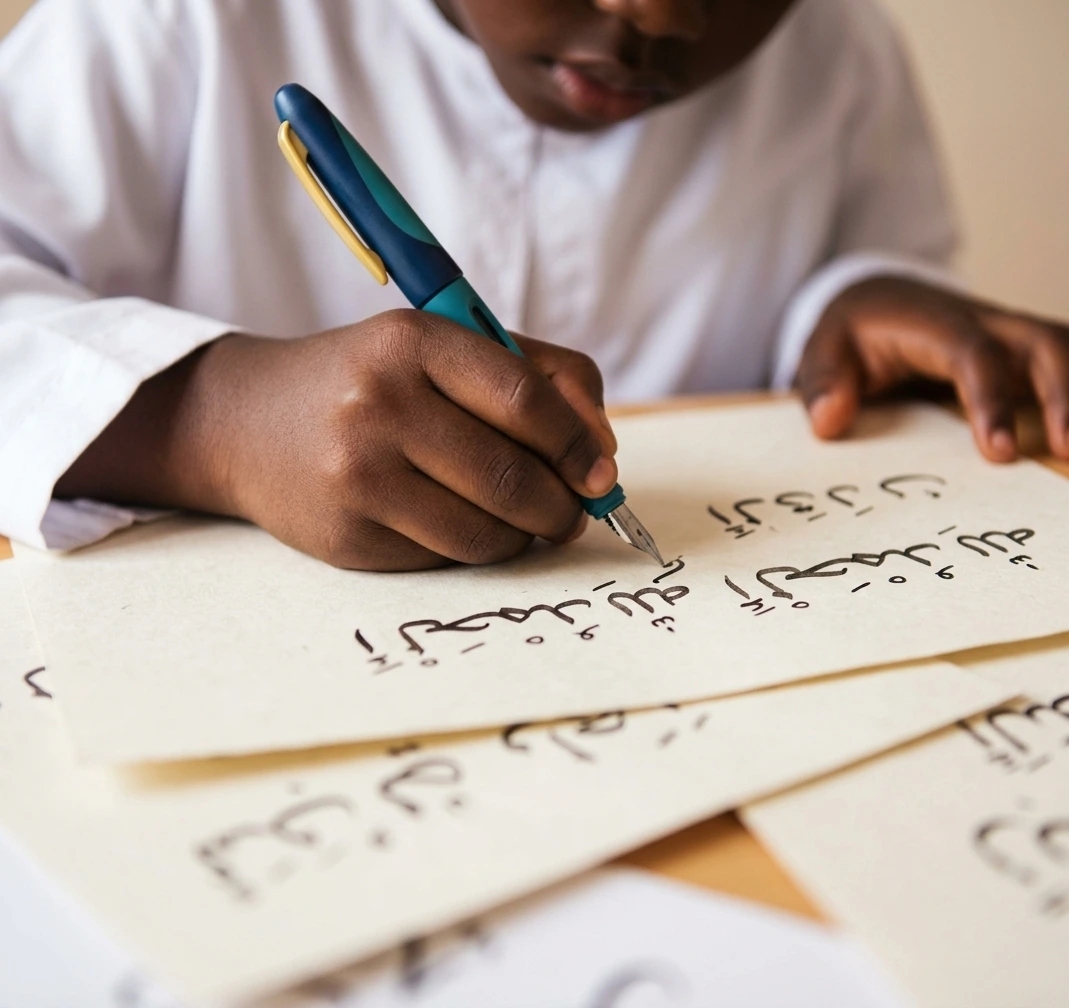
What you do between lessons matters as much as the lessons. Without practice, the corrections made in class fade by the next session and the teacher ends up repeating the same points.
This is a practice plan for the sessions themselves: what to do in those ten to fifteen minutes. For when to do them across the week, see the weekly routine.
Table of Contents
What you need
- The assigned page or passage, in the same mushaf or book used in lessons.
- A notebook and pencil for corrections.
- A timer. Setting 10 or 15 minutes removes the question of "how long should I do this?"
- A recording of a reliable reciter, if the teacher recommends one.
The four-step session
- Listen (2 minutes). Play the assigned passage once and follow along with your eyes. Notice how the reciter handles the parts you find difficult.
- Read slowly (4 minutes). Read aloud at a pace you can control. Do not rush; accuracy first, speed later.
- Fix the corrections (4 minutes). Open the notes from your last lesson and practise the two or three corrections the teacher made, on their own and in context.
- Record or recite once (1-2 minutes). Say the passage once without stopping, or record it. This is your check, and your evidence of progress.
A day-by-day example
Assume lessons on Monday, Wednesday and Friday.
| Day | Practice focus |
|---|---|
| Mon (lesson day) | Short read-through afterwards while it is fresh |
| Tue | Full four-step session on Monday's material |
| Wed (lesson day) | Warm up before class by reading the previous assignment |
| Thu | Full four-step session on Wednesday's material |
| Fri (lesson day) | Warm up, then relax after class |
| Sat | Light listening, and one recorded recitation of the week's best passage |
| Sun | Rest, or a five-minute review of your corrections notebook |
For children: how a parent can help
- Sit nearby while the child practises. You do not need to correct anything.
- Let the child choose the order of the first two steps.
- Celebrate the effort: "I heard you fix that word on your own."
- Stop at the timer, even if the child wants to continue or has not "finished".
For adults: make it fit
Choose a fixed trigger: after Fajr, on the commute with headphones for the listening step, or after dinner. If you only have five minutes, do steps 1 and 3. Short and consistent beats long and occasional.
Keep a corrections notebook
One line per correction: the word, what went wrong, the right way. Review it before each lesson. Over a few weeks, you will see which mistakes have gone and which are stubborn, and you can ask the teacher for targeted help.
If a session goes badly
Some days nothing works. Finish with one clean reading of a short, familiar passage so the session ends on success, and move on. Tell the teacher next lesson what felt difficult.
Frequently asked questions
Continue your learning with Quran Memorization at Home: A Practical Family Plan, How to Do Hifz Quran at Home: A Practical Memorization Plan, Learning Quran with Tajweed at Home: A Five-Step Plan.
 Talqeen Academy
is a globally recognized platform for learning the Quran, Arabic,
and Islamic Studies through personalized one-on-one online sessions with expert tutors.