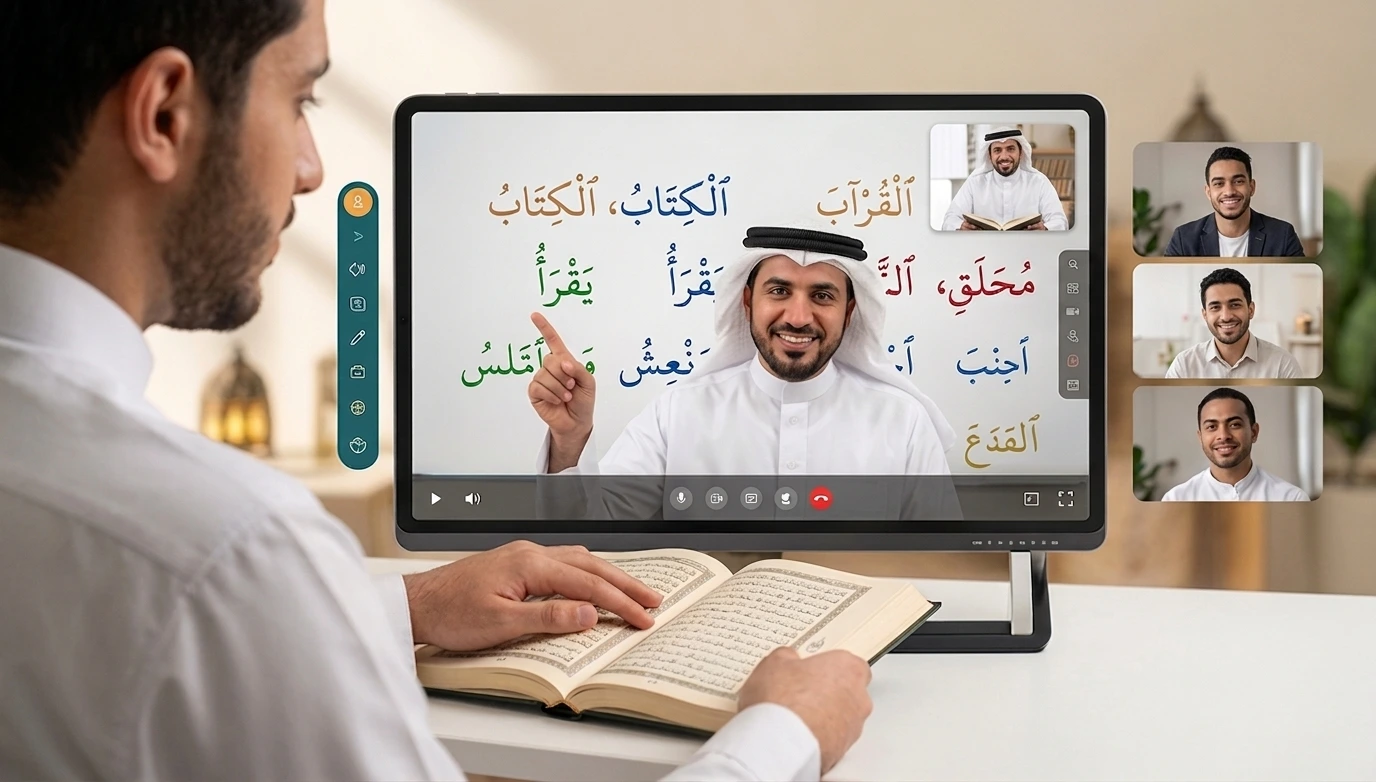
UK families choosing Hifz lessons often want careful recitation, reliable revision, discipline, and appropriate supervision. Both a local madrasa and an online programme can work toward those aims, but the actual teaching arrangements may differ.
The source article favours online Hifz for many busy families because of individual attention, reduced travel, revision tracking, and parent updates. Local classes may offer a strong routine and a learning community. A useful decision compares the specific programmes available to your child rather than assumes every online class is better than every madrasa.
Table of Contents
Why the Learning Method Matters
Hifz combines memorization with accurate recitation and maintained recall. Progress is not only the number of new pages learned; earlier material needs daily attention and correction.
Children in the UK also manage school, homework, and family activities. Travel and a fixed class time may fit one household well and create fatigue for another. The plan should leave room for a calm lesson and a workable revision routine.
A weak system can make retention harder in either format. Look for realistic targets, enough direct recitation, and a way to identify forgotten passages before more material is added.
What Online Hifz Learning Involves
Online Hifz typically involves live recitation to a teacher through a video platform. A suitable plan tracks new learning, recent revision, older review, and the feedback needed between sessions.
The source describes home-based children's lessons with parent updates and no commute. Confirm those features in the actual course, including class size and how much time the tutor listens to your child.
Potential Benefits of Online Hifz
An individual lesson can adapt to a learner's memory and reading needs. The source lists six advantages:
- One-to-one attention for correction and confidence.
- Available times that can fit school and work routines.
- No daily journey to class, reducing travel time and fatigue.
- A wider search for qualified Huffaz beyond the local area.
- Daily revision tracking where the programme provides it.
- Parent visibility through progress updates.
A quiet home space can support these features. They depend on the family's setup and the provider's actual practices, not simply on using a screen.
Explore guided Quran memorization lessons
Possible Limitations of Online Hifz
The lesson needs a stable connection and clear audio. Younger children may need a parent nearby to help them stay engaged, and individual remote lessons provide less physical peer interaction than a classroom.
A dependable routine can help some families manage these issues. For others, technical interruptions, screen attention, or the lack of a group remain important limitations. Assess the child through an actual lesson rather than assume routine will solve every difficulty.
What a Local Madrasa Offers
A local Hifz madrasa provides in-person lessons at agreed times, often after school or on weekends. Some operate in groups where a teacher divides attention, while others arrange smaller classes or individual recitation. Check the actual class size and pace.
The source points to travel, weather, and limited correction time as possible difficulties. These vary by location and institution. A nearby, well-run class may fit the family more conveniently than the general comparison suggests.
Potential Benefits of Local Classes
- A fixed attendance routine can support a regular habit.
- Peer learning may encourage motivation and a sense of shared purpose.
- Face-to-face listening can support detailed pronunciation correction.
A classroom may suit a child who responds well to an in-person learning environment. Families living nearby may also find the journey simple to maintain.
Challenges to Ask the Madrasa About
The source describes a model in which larger groups reduce the time each child has to recite. It names six concerns:
- A large class and limited individual teacher attention.
- Fixed times that may clash with school or family duties.
- Travel that adds fatigue and consumes time.
- Insufficient revision because lesson time is short.
- Limited parent feedback.
- Travel, weather, location, or supervision concerns that affect attendance and comfort.
These are questions to investigate, not established shortcomings of every UK madrasa. Ask how the institution manages them and whether the child's timetable remains realistic.
Compare the Actual Programmes
The source's table contrasts an individual online model with a larger local class. The following version retains all nine comparison factors while making the conditions explicit.
| Factor | Online Hifz | Local madrasa |
|---|---|---|
| Class size | May be one-to-one or a small group; confirm the format. | May be a larger group; ask the actual number of students. |
| Teacher attention | Individual classes can focus on one student's reading. | Group teachers divide attention; check direct recitation time. |
| Schedule | Available slots may allow more choice. | Usually has set attendance times that may or may not suit the family. |
| Travel | Home lessons remove the class commute. | Travel is needed unless the class is very close. |
| Revision | Ask whether daily review is tracked and tested. | Ask how review fits into the class and home assignments. |
| Parent involvement | Home observation and updates may be available. | Feedback arrangements depend on the institution. |
| Safety and supervision | Check home supervision, platform access, and safeguarding. | Check travel, location, supervision, and safeguarding. |
| Learning pace | Individual lessons may adapt to the student. | Ask how a group programme adapts targets for different learners. |
| Retention | Strong recall depends on effective review and correction. | Strong recall likewise depends on the review system and teaching. |
Which Option Fits Your Child Better?
The source concludes that online Hifz gives most UK families more control over timing, revision, individual feedback, and travel. Those features may indeed solve a particular family's difficulties when the course delivers them.
A local madrasa can also work well when the schedule is manageable, the teacher listens carefully, and the programme maintains earlier memorization. Compare a trial or observed lesson, the review plan, and communication rather than select solely by format.
Use the child-teacher selection guide and the online Hifz tutor checklist to make the comparison more concrete.
Choose a System That Supports the Student
Hifz needs patience, structure, and repeated care. The learning arrangement should leave the child able to concentrate, receive correction, and review regularly without an unnecessarily exhausting routine.
Whichever format you choose, a children's Hifz programme should provide structured new learning, revision and meaningful progress checks. Use a trial lesson to see how the teacher applies these principles to your child.
Once lessons begin, keep a record of new learning and revision and review it with the teacher. That evidence will show whether the arrangement is supporting retained progress.
Find a suitable Quran memorization pathway
Related Reading and Learning Options
Explore related articles and course options below. External Quran and language references are retained where they support the topic.
- online Hifz classes
- Hifz Classes for kids
- Enroll In Online Hifz Course Today
- online hifz cours for kids
 Talqeen Academy
is a globally recognized platform for learning the Quran, Arabic,
and Islamic Studies through personalized one-on-one online sessions with expert tutors.