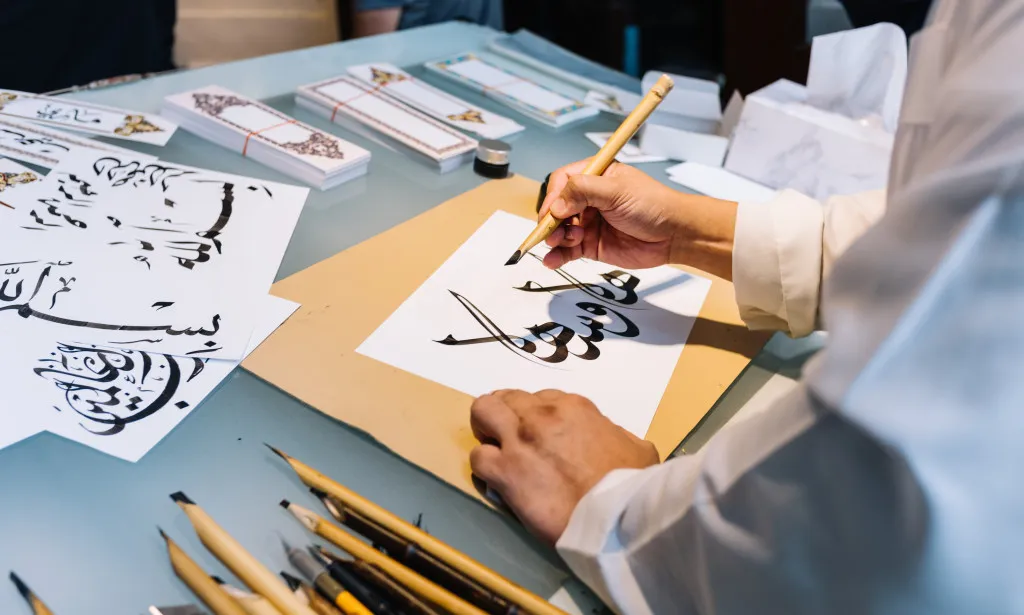
Learning the Arabic alphabet gives beginners a practical starting point for reading the Quran, writing Arabic and exploring a new language. The commonly taught alphabet has 28 letters. Recognising those letters is an important foundation, but fluent reading and understanding also require vowels, connected forms, vocabulary and guided practice.
The source promoted native-speaking tutors, audiovisual activities, individual lessons and flexible online scheduling. These describe its advertised approach, not verified services or outcomes at Talqeen. Evaluate a course by the feedback it provides and the skills it actually teaches.
Table of Contents
Eight Steps for Learning Arabic Letters
1. Become Familiar with the Alphabet
Begin with letter names and basic shapes, remembering that Arabic is generally written from right to left. An Alif, Ba, Ta sequence offers a manageable introduction. Look at the letter, hear its sound and identify it among similar shapes before trying to read a long word.
2. Study Small Groups and Their Forms
The source suggested groups of three to five letters. Use that as an adjustable starting point. Practise isolated, initial, medial and final forms where applicable. Not every letter joins to the following letter, so a chart should teach joining behaviour rather than implying four fully connected forms for every letter.
3. Practise Joining Letters
Compare a letter on its own with the same letter inside a word. Arabic joining can initially feel unfamiliar to someone used to English print. Trace examples, then write them independently and explain where a connection ends. This helps turn shape recognition into actual reading.
4. Combine Visual Lessons with Audio
Qaida lessons, demonstration videos and suitable apps can connect the written shape with a spoken model. Pause and repeat short examples instead of watching an entire lesson without practising. These resources support instruction; their presence alone does not establish a teacher's qualifications.
5. Get Help with Unfamiliar Sounds
Some Arabic sounds have no exact English equivalent. Listen to a clear model and ask a capable teacher to check your articulation. Being a native speaker does not by itself demonstrate the ability to teach Quranic pronunciation. Choose someone who can explain and correct errors patiently.
6. Write a Little Every Day
Spend a few minutes writing isolated letters and then examples in words. Compare dot placement, shape and joining with a reliable model. Accurate short practice is more useful than repeatedly copying an error across a page.
7. Revisit Earlier Letters
Include a brief daily review before adding unfamiliar shapes. Mix older and newer letters, read them in different positions and record the ones you confuse. A small review habit keeps early lessons available as the alphabet grows.
8. Use Varied Activities
Flashcards, worksheets, matching games and short quizzes can make practice more engaging. Change the activity when attention fades, while keeping the same learning objective. A learner should eventually recognise letters outside the game or worksheet where they first learned them.
What Alphabet Learning Can Support
- Quran reading: recognising letters supports access to the Arabic text. Meaning and accurate recitation require additional study.
- Thinking and practice skills: remembering shapes and solving reading exercises involve attention and recall. The source's broad claims about better memory, problem-solving and multitasking were not supported by an identified study.
- Cultural exploration: letters open a route toward literature, poetry, art, music and conversations; understanding these requires language knowledge beyond the alphabet.
- Longer-term professional goals: Arabic proficiency may be relevant to business, international relations or academia. Alphabet knowledge alone does not establish professional fluency or guarantee employment.
Choosing a Course and Tutor
The source described three course categories: Noorani Qaida for reading foundations, an Alif Ba Ta introduction to letters, and Quranic Arabic for vocabulary and grammar. Compare their actual syllabuses rather than assuming one course covers all three objectives. See Quran reading foundations and Quranic Arabic study.
A suitable tutor checks your current level, offers individual feedback and adjusts the pace. Ask what any claimed certification covers and whether the teacher can teach your age group and language background. Native-language ability and teaching ability are related but different qualifications.
The original enrolment sequence involved visiting a provider's website, browsing courses, selecting a goal, taking a trial if available, registering and starting lessons. Confirm present terms before sharing details or paying. Talqeen's course information is the appropriate place to check its own offerings.
How Long Should Beginners Allow?
The source gave two to four weeks as an alphabet-learning estimate and described it as typical. No supporting completion data was supplied. Some learners recognise letters within that period while needing longer for connected reading and pronunciation. Measure progress by independent reading, not a promised deadline.
Words can be introduced alongside letter practice once the relevant shapes and vowels are understood. There is no need to postpone every meaningful example until every chart has been completed. Consistency, manageable tasks and corrected practice make this foundation more useful.
 Talqeen Academy
is a globally recognized platform for learning the Quran, Arabic,
and Islamic Studies through personalized one-on-one online sessions with expert tutors.