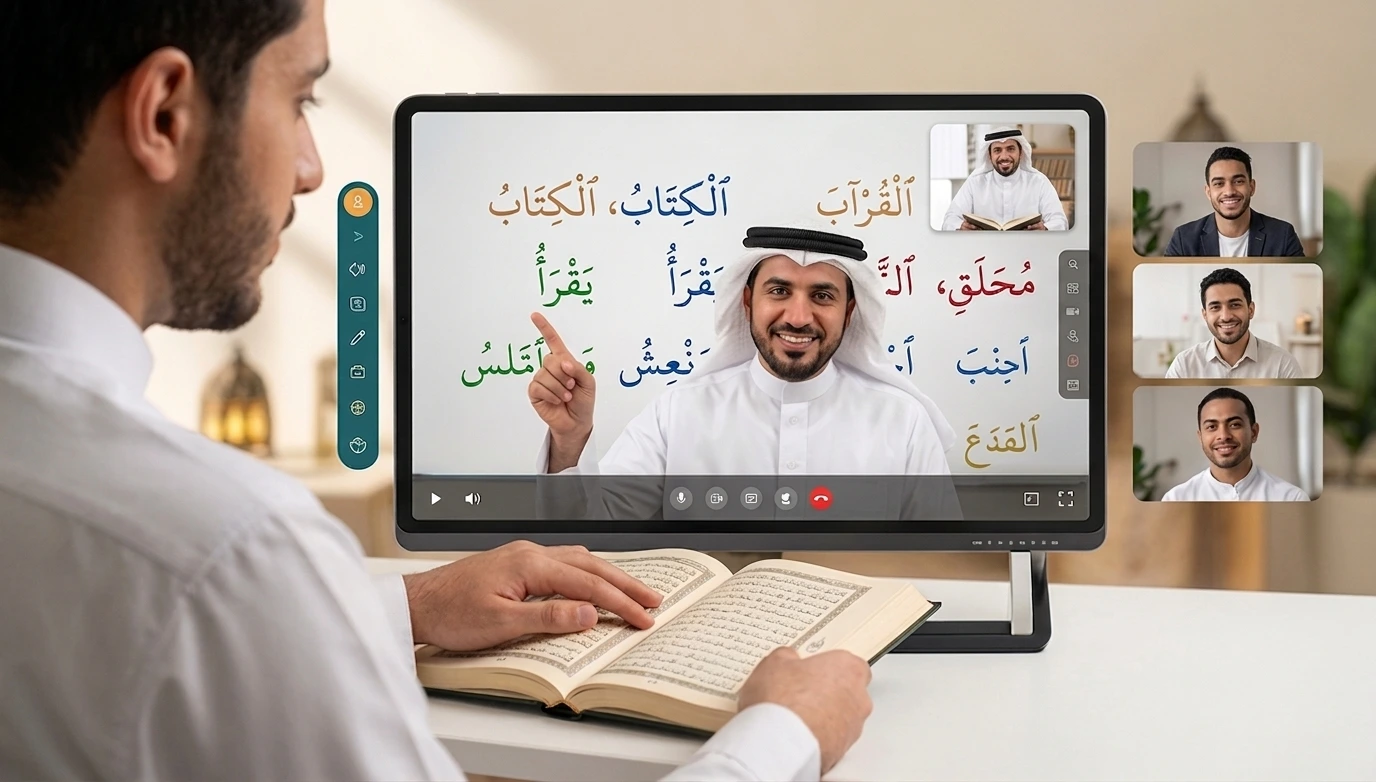
Online Quran classes can be useful when travel or a busy schedule makes local attendance difficult. Learning from home may provide access to different teachers, individual lessons and digital review tools. A traditional madrasa can also provide strong teaching, community and a regular study environment.
The source argues that online classes are the better choice. A more useful comparison asks which actual programme meets the learner’s needs. Neither delivery format guarantees flexibility, safety, affordability or teaching quality. The five broad distinctions and ten detailed topics below help you compare the options fairly.
Table of Contents
Five Features to Compare First
The original table contrasts personalised lessons, teacher location, distractions, materials and accommodation of learner needs. These can differ between programmes, but local classes are not all fixed, crowded or limited to printed books.
| Feature | Possible online arrangement | What to check in a local madrasa |
|---|---|---|
| Learning goals | Individual lessons may be adapted to personal goals. | Ask how the syllabus and individual targets can be adjusted. |
| Teacher access | A remote course can connect learners with teachers elsewhere. | Assess the relevant knowledge and experience of local teachers. |
| Distractions | One-to-one lessons remove classroom interruptions, but home distractions remain possible. | Observe class size, behaviour and opportunities for focused practice. |
| Learning materials | Digital notes, shared pages or recordings may be available. | Check both printed and digital resources actually provided. |
| Individual needs | Remote teaching may allow tailored scheduling or pacing. | Ask about accessibility, learning support and adaptations rather than assuming they are absent. |
10 Ways Online Classes May Fit a Learner’s Needs
1. More suitable scheduling options
Working adults, school children and families may need different study times. An online provider with available early, evening or weekend slots can help when a local timetable does not fit. That convenience can support attendance without a commute.
Availability is still finite. Confirm recurring lesson times, time zones and missed-class arrangements; online learning does not mean you can attend at any moment or never miss a lesson. Compare these details with the local option.
2. Recorded explanations for later review
Where a programme includes recordings, students can return to a difficult explanation or revise the assigned material outside the live lesson. This may help with catching up after an absence or preparing for an assessment.
Ask whether recordings are actually provided and how access and consent are handled. Local teachers may also supply review material, and a recording cannot replace the live correction of your own recitation. Do not assume that missing a local class leaves no possible way to catch up.
3. A wider pool of teachers
Remote learning can connect you with teachers beyond your immediate area. You may find someone whose relevant specialism matches Tajweed, Hifz or Tafsir, or who can explain the lesson in a language you understand.
Global access is not proof that a teacher can answer every question or is better than a local scholar. Check the scope of their knowledge, teaching experience and willingness to refer questions beyond it. Read how to assess an online Quran teacher.
4. One-to-one attention where offered
An individual lesson gives the teacher more time to hear your reading, identify errors and adjust the next task. It can also help a learner ask questions without waiting for a large group. This may build confidence when the feedback is clear and encouraging.
Not every online class is individual, and some local programmes offer personal attention too. Compare actual lesson size and the amount of reading time each student receives. Explore Talqeen Academy’s course options and ask about the relevant format.
5. Interactive tools that clarify a lesson
A virtual whiteboard, shared page, video call or quiz can help a teacher demonstrate a pattern and check understanding. Suitable games may make children more willing to participate when tied to a clear learning target.
Tools do not automatically make a lesson effective. Watch whether the child or adult actually reads, answers and receives correction. A well-taught local lesson can be engaging, while a digital lesson can still become a long lecture.
6. Home access and reduced travel
Studying at home can avoid a long commute and provide a familiar setting. Parents may find it easier to observe younger children’s lessons and understand their progress. These arrangements may also suit families seeking a convenient format for girls or other learners.
Familiarity does not automatically establish safety. Check supervision where needed, teacher conduct and communication arrangements, alongside the local madrasa’s travel and classroom conditions. Choose based on the actual environment rather than a blanket claim about either format.
7. Possible savings on attendance costs
Remote lessons can remove travel expenses and some costs associated with attending a physical course, such as particular materials or uniforms where those are required. Free supplementary recordings and resources can also support revision.
Include tuition, internet, equipment and all package conditions in the comparison. Some local classes are inexpensive or community-supported, while an individual online course may have a higher fee. Ask about the full price and cancellation arrangements rather than assuming there will be no extra costs.
8. A pace adapted to the learner
When a programme is personalised, the teacher can spend longer on a difficult sound or move forward once a target is secure. This can help a learner who needs more time and another who is ready for a new challenge.
Ask how the plan changes after weak recall or a missed week. Local teaching can also be differentiated, and an online course can have a rigid syllabus. The useful feature is responsive teaching, not the screen itself.
9. A choice of course goals
The source lists five learning areas that an online provider may offer. Check the current course content and prerequisites, since these goals overlap without being identical.
- Tajweed: pronunciation and the rules of Quran recitation.
- Quran memorisation: new Hifz with a continuing revision plan.
- Translation study: learning interpretations of meanings in a language the learner understands.
- Tafsir: explanation and context studied with appropriate guidance.
- Quranic Arabic: language foundations that support engagement with the text.
Choose the current priority rather than assuming one course covers every area fully. Continue with planning Quran study to connect the goals.
10. Immediate feedback and visible progress
A live teacher can correct a mistake as you read and show how to practise the changed sound. Records may include lesson completion, test results, recurring errors and material ready for review. Parents can use these updates to support practice between classes.
Ask what is actually recorded and how progress is assessed. Scores or completed pages should not replace listening to accurate recitation. A local teacher can also provide timely feedback, so compare the real process and the attention available.
How to Choose Between the Two Options
Observe a lesson if possible and compare the teaching, schedule, cost and revision expectations. Consider whether the learner benefits from a local group and community or needs the convenience and individual format available remotely.
For children, include the parent’s ability to supervise and reinforce practice. For Hifz, look beyond new-learning targets to how older memorisation stays secure. See online Hifz benefits and checks for a focused comparison.
Compare Programmes, Not Just Delivery Formats
Compare online and local lessons through teacher competence, correction, participation and the practical support available. Choose the setting that fits the learner rather than assuming one format is always superior.
Online study may offer the combination of access, scheduling and individual feedback your family needs. A suitable local madrasa may also serve those goals well. Choose the programme whose actual teaching and practical arrangements support accurate, consistent learning.
Related Reading and Learning Options
Explore related articles and course options below. External Quran and language references are retained where they support the topic.
- online Quran classes
- Start Your Online Quran Classes Today
- Tajweed Rules
- Quran Memorization
- Hifz course
- Tafseer Studies
- Quranic Arabic
- Egyptian online quran teachers
- quran classes for kids
- quran classes for sisters
- quran classes for adults
 Talqeen Academy
is a globally recognized platform for learning the Quran, Arabic,
and Islamic Studies through personalized one-on-one online sessions with expert tutors.